RECORD
A Passage to India
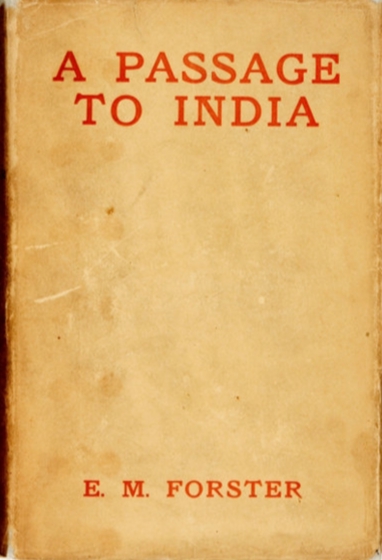
- Title:
- A Passage to India
- Author:
- E.M. Forster
- Date of Publication:
- 1924
- Description:
- A Passage to India is a 1924 novel by English author E. M. Forster set against the backdrop of the British Raj and the Indian independence movement in the 1920s. It was selected as one of the 100 great works of 20th-century English literature by the Modern Library and won the 1924 James Tait Black Memorial Prize for fiction. Time magazine included the novel in its "All Time 100 Novels" list. The novel is based on Forster's experiences in India, deriving the title from Walt Whitman's 1870 poem "Passage to India" in Leaves of Grass. (Source: Wikipedia)
- Keywords:
- Ethics Experience Place Spirituality Supernatural
- Religions:
- Locations:
- Wikidata Entity ID:
- https://www.wikidata.org/wiki/Q622303
- Open Library ID:
- https://openlibrary.org/works/OL58978927M
- Item Type:
- Text
- Item Image Format:
- image/jpeg
Keyword Engagements
- Ethics
- Forster’s Passage to India offers a set of human-centred values to replace the Christian moral code which is reduced to an alibi for colonial and class hierarchies and bourgeois propriety. As in his other novels and non-fiction the keynotes of his ethics are love, tolerance and sympathy and in isolated episodes across the novel these values allow for connection and understanding cross-class, gender and religion. Forster’s best-known discussion of these values appears in ‘What I Believe’. He is often held up as a key figure in the development of the modern Humanist movement in Britain.
- Experience
- Foster’s Passage to India describes the colonial infrastructure of India towards the end of Empire and at the beginning of the transition to independence. The novel features the Civil Station where the British officials live and the Chandrapore Club which Indians are not allowed to enter. The Government College run by the Principal Mr Fielding appears more enlightened and it is here that the British characters encounter Indians from the professional classes including Dr Aziz and Professor Godbole. After Adela Quested accuses Aziz of assault he is put on trial at the Court where it seems the machine of justice will run inexorably to the only possible outcome. These institutions are contrasted unfavourably with Indian religions which hold out at least the possibility of unity and cross-cultural understanding. Both the Mosque and the Hindu festival at the end of the novel appear at least provisionally or in aspiration to be more inclusive in nature.
- Place
- Forster’s Passage to India has three parts named for three key locations: Mosque, Cave and Temple. Part I sees the arrival of Englishwomen Mrs Moore and Adela Quested who expects to marry Mrs Moore’s son in the fictional city of Chandrapore in British-ruled India. The mosque is the site of a key encounter between the Muslim Indian doctor, Aziz, and the English tourists where following a misunderstanding there seems a rare moment of connection between cultures. Other key scenes in part one include the Civil Station and the Chandrapore Club where the British officials and visitors live and socialise. Part two is named for the Marabar caves invoked in the first sentence of the novel as the exception to the rule that there is nothing worth seeing in the area. The caves host the pivotal event in the novel though the exact nature of that event is famously withheld from the reader. Adela disappears and accuses Aziz of assaulting her (an accusation she later retracts) while Mrs Moore experiences a spiritual crisis prompted by the strange echo, ‘Boum’, in the cave. Part III of the novel is named Temple and describes a Hindu festival which takes place several years after the events of Part II. The festival celebrates the god Krisha and would seem to anticipate an independent India in which values of unity and love triumph over colonial division and conflict.
- Spirituality
- In a Passage to India Forster rehearses and challenges orientalist discourses contrasting the spirituality of India (disorganised and unable to modernize without English direction) with the materialism and rationality of England and English Public School Christianity (small and incapable of great feeling). India’s spirituality is identified as a key source of the ‘muddles’ and division in the novel. And yet there are also several examples in the novel where spirituality appears as a unifying or transcendent force allowing characters to apprehend if not overcome the limits colonial, social and religious differences. Following her visit to the Marabar caves for example Mrs Moore has a sudden intuition of the smallness of Christianity as compared to the vastness of the cosmos. The penultimate scene of the novel takes place at a Hindu festival for Krishna where a choir perform before the state-sponsored inscription “God is Love”. The inscription aspires to a condition of spiritual universality at the same time that the misspelling suggests its failure.
- Supernatural
- The plot of Foster’s Passage to India turns on an event in the Marabar caves which may or may not be supernatural in origin. During a visit to the caves by the English tourists Adela Quested and Mrs Moore in the company of the Indian Dr Aziz Adela vanishes and seemingly hallucinates an assault by Aziz. Mrs Moore experiences a spiritual crisis prompted by the strange echo in the cave, ‘Boum’. Forster wrote of the source of the echo that it was ‘either a man, the supernatural or an illusion’ but withholds explanation for either of these occurrences. Other suggestions of the supernatural in the novel include the appearance of a mysterious animal supposed to be a hyena.
Attribution
- Citation:
- "A Passage to India", Mapping Religion in the Global Anglophone Novel (MaRGAN), https://ghjensen.github.io/margan/items/margan010.html
Rights
- Rights:
- Metadata and other content produced by the MaRGAN team for this website is free for teaching and research purposes, provided appropriate credit is given. See https://creativecommons.org/licenses/by/4.0/ for more information.
- Standardized Rights:
- https://creativecommons.org/licenses/by/4.0/