RECORD
The Prevalence of Witches
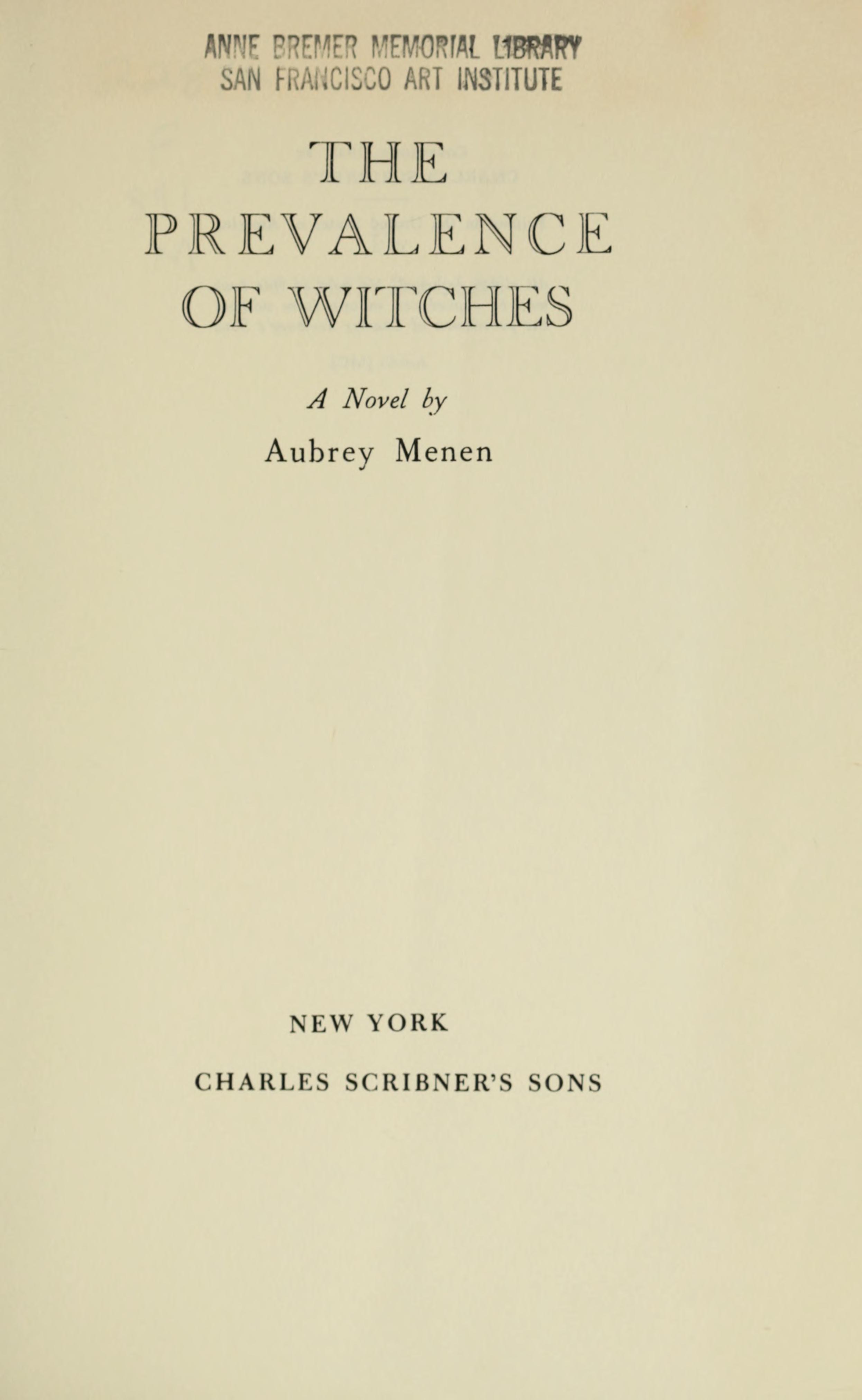
- Title:
- The Prevalence of Witches
- Author:
- Aubrey Menen
- Date of Publication:
- 1947
- Keywords:
- Afterlife Belief Holy People Institutions Performance
- Religions:
-
Christianity-Protestant majorHindu majorRationalist major
- Locations:
-
India major
- Wikidata Entity ID:
- https://www.wikidata.org/wiki/Q133716611
- Open Library ID:
- https://openlibrary.org/works/OL6029501M
- Item Type:
- Text
- Item Image Format:
- image/jpeg
Keyword Engagements
- Afterlife
- In Aubrey Menen’s “The Prevalence of Witches,” there is an emphasis on afterlife and the role it plays amongst the people of Limbo, otherwise known as Limbodians. The name alludes to the “limbo” between life and death. The local religion, which is called witchcraft by the narrator and his Western counterparts, holds that witches are unable to truly die. They can go through the act of dying, but their souls will continue to live on a spiritual plane with the other witches who have “passed.” This local belief plays a significant role in the novel’s main conflict, which is that the village headman is being tried for the murder of a witch. According to Limbodian customs, the headman is not considered guilty for his actions because witches (often described as mischievous, meddling, and irksome) cannot truly die. It is up to the narrator (the colonial Education Officer), an accompanying American missionary, and a phony Swami to convince the judge that the headman has not committed any crime because of the Limbodian belief system, otherwise he will be executed if found guilty.
- Belief
- “The Prevalence of Witches” by Aubrey Menen addresses the concept of beliefs and the differences between beliefs. The Limbodians’ belief in witchcraft is central to the major conflict, which is the murder of a local witch by the village headman. In Limbodian belief, he isn’t guilty as witches are considered a real threat to Limbo. However, the group of main characters has to prove these beliefs to the judge, who identifies as a Rationalist and rejects the validity of religious beliefs. Outside of the Limbodians, one of the main characters– Cuff Small– is a Reverend of the Christian church. When he was younger, he had a religious experience wherein he had a vision of God. When he explains this experience to the Limbodian headman, the conversation has to be translated into Limbodian and he, with difficulty and comic effect, translates his experience and beliefs through the lens of the Limbodian beliefs.
- Holy People
- There are three types of “Holy People” that are depicted in “The Prevalence of Witches” by Aubrey Menen: Swamis, missionaries, and witches. While the title “witch” is ascribed to any woman that appears to be an inconvenience, there are two central characters that portray a Swami and a missionary: Swami Ananda and Reverend Small (also known as “Cuff”). Although the role of being a “Holy Person” conventionally indicates being saintly or mystical, each of these characters stray away from those preconceived notions. While Swamis are viewed as self-disciplined teachers or saints who choose to live a simple life, Swami Ananda is a complete contradiction of that. Instead, he takes on the role of a Swami so he can con people—in this case, he works with the British officers to convince the judge that the religion is real by attempting to perform a fraudulent miracle. Reverend Small, on the other hand, differs because, although he does believe in Christianity, he initially had no intention of being a missionary. He’d been coerced into becoming one by his mother because he was perceived as being not intelligent enough. If he was a missionary, then he would at least be viewed as an honorable and holy man, which he does sincerely end up being. His belief in God comes from his own spiritual experience as a child, and he appears to be the only sincere holy person. However, Catullus, the main colonial administrator of Limbo, is presented too as a saint, or at least a saintly type by the end of the novel.
- Institutions
- There are three main institutions that Aubrey Menen represents in “The Prevalence of Witches.” There are Limbodian customs and their native language, which are in tension with the institutions of British colonialism. Every aspect of Limbodian life is called into question because the Limbodians are monitored by the British government and are obligated to adhere to its social norms. Initially, Limbodians lived their lives being nude, but once the British occupied their land, they had to wear loin cloths and other types of clothing to cover whatever was deemed “improper.” Most of the headmen, who were the leaders of their villages that were in contact with the British officers, wore uniforms despite that not being their traditional attire. Another institution in the novel was the use of ethics and morals in the court of law. Limbo, which initially seemed to lack a structured legal system, was forced to adhere to British law. That directly ties into why one of the headmen was being charged for the murder of a witch; if the British weren't involved, then there most likely wouldn’t have been a trial, or a crime. The missionaries have been incentivized by their religious organizations to convert Limbodians into Christianity by creating churches and schools for the village children.
- Performance
- Aubrey Menen represents a range of types of performances in "The Prevalence of Witches." Throughout the novel, multiple characters perform translations across Limbodian and British language and beliefs. There is repeated focus on the act of having to find equivalent words in Limbodian for British concepts. Outside of translation, the first chapter of the book goes into the types of performances that the Limbodians are doing for the British, such as only wearing clothes when the British occupy the country. As part of the British occupation, there are attempts to force education and British culture onto the Limbodians, including the production of dramatic staging of the Limbodian creation story, performed through a heavily westernized perspective. At one point, the character of Catullus proposes the idea of producing ‘primitive’ Limbodian art in order to turn a profit, turning even the act of making art into a performance. When the village headman kills a witch, something he views as a legitimate threat, he is jailed for murder under British law. The surrounding court case and trial turns into its own performance as the main characters have to prove the Limodian belief of witches. They do this via bringing in the Swami, a con man who makes his living through the performance of faking rituals. While the Swami was brought in to a fake miracle, for a time it appears he performed a real one in the form of healing a Limbodian boy, an action that shakes the Swami significantly.
Attribution
- Citation:
- "The Prevalence of Witches", Mapping Religion in the Global Anglophone Novel (MaRGAN), https://ghjensen.github.io/margan/items/margan019.html
Rights
- Rights:
- Metadata and other content produced by the MaRGAN team for this website is free for teaching and research purposes, provided appropriate credit is given. See https://creativecommons.org/licenses/by/4.0/ for more information.
- Standardized Rights:
- https://creativecommons.org/licenses/by/4.0/