RECORD
The Surrounded
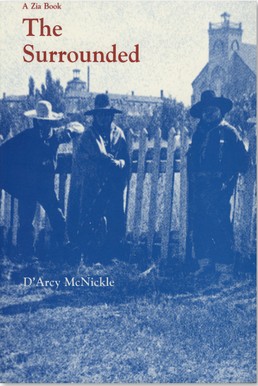
- Title:
- The Surrounded
- Author:
- D'Arcy McNickle
- Date of Publication:
- 1936
- Description:
- The Surrounded, D’Arcy McNickle's first book, was first published in 1936 by Harcourt, Brace and Company then republished in 1964 and again in 1978 by the University of New Mexico Press. McNickle was a Cree Métis author enrolled as Salish-Kootenai on the Flathead Indian Reservation. (Source: Wikipedia)
- Keywords:
- Arts Community Experience Institutions Place Ritual
- Religions:
- Locations:
-
United States major
- Wikidata Entity ID:
- https://www.wikidata.org/wiki/Q65117345
- Open Library ID:
- https://openlibrary.org/works/OL6333731M
- Item Type:
- Text
- Item Image Format:
- image/jpeg
Keyword Engagements
- Arts
- Religion and the arts are interwoven in McNickle’s portrayal of Archilde Leon, whose musical gifts position him at a crossroads. Having spent time in Portland pursuing a career as a violinist, he returns to his family uncertain whether to commit to his musical training or remain among his people. Within the valley, music finds its outlet in the Church, where twice a week Archilde plays violin alongside Father Christodore at the piano. His relationship to the institution seems primarily aesthetic and, while he admires the frescos and paintings, he can no longer feel the power of the Chrisitan message within them. For Archilde the Church is primarily a ‘theatre of movement and ceremony’ rather than a place of worship.
- Community
- Community in The Surrounded is already fractured along the fault lines of settlement and assimilation before the novel’s action begins. Max Leon, Archilde's Spanish father, is a representative of the Old World settler culture that has reshaped the reservation, yet his fluency in Salish registers his long accommodation to the community he married into. The novel registers the historical process by which the Salish peoples of western Montana and northern Idaho surrendered their territorial claims in exchange for a fixed plot of land and compensation that proved largely worthless. Max has navigated this transition shrewdly and this sets him apart from figures like Moser, the Indian trader who arrived too late and reinvented himself unsuccessfully as a merchant. The ongoing encroachment of the outside world is registered in the midsummer festival towards the end of the novel where traditional customs sit uncomfortably alongside a bucking contest and a baseball game.
- Experience
- In The Surrounded, conversion to Christianity is shown to be unstable and ultimately reversible. Catherine Le Loup, daughter of Running Wolf, is renamed Faithful Catherine by the mission sisters, and this becomes the only identity she consciously knew. Yet following her return from the mountain and her involvement in the killing of a man, she comes to feel herself beyond Christian forgiveness, and quietly she reverts, becoming a ‘pagan’ again. Her alienation from the faith finds its sharpest expression in a dream in which she dies and ascends to heaven, only to discover that it is a white man's heaven. Archilde’s own estrangement follows a different course and suggests the secularizing influence of the city. His return home makes him recognise that Christianity had already slipped away from him with his childhood, and he stops attending church and tries to persuade his nephew Mike that the stories told to him by the Fathers are nothing but lies.
- Institutions
- In The Surrounded, the religious institutions that shape Salish life form an interconnected network of colonial authority. The Christian mission was created by the Jesuit Order around 1854 and one of their founding members, Father Grepilloux, has returned to die in the valley he helped transform. From the Mission other institutions extend outward. These include an Indian School in Oregon where Archilde learns the violin, not as part of the official curriculum but in secret from the school printer, and the Catholic Mission school where his mother learned household management from the Sisters. The human cost of these institutions is most visible in Archilde’s nephew Mike, who returns from the mission school traumatised by harsh punishment and tormented by visitations from the Evil One. The Indian Agency also features prominently in the novel making clear the connections between the religious and secular manifestations of state power.
- Place
- Place in The Surrounded is layered with competing histories and meanings. Archilde returns not simply to a ranch in Montana but to the Sniél-eman valley, a landscape whose Salish name registers the Indigenous presence that white settlement has sought to displace. Against this backdrop, the holy mission town of St. Xavier looms large, its church dominating what is called the Old Town (the Indian-town) in a piece of spatial symbolism that reveals the colonial and religious forces that have shaped the community. Archilde’s return from Portland, where he has been playing violin in an orchestra, sharpens the novel's sense of place as a site of tension between worlds. His homecoming becomes an encounter not just with family but with the accumulated weight of a place caught between Indigenous memory and colonial transformation.
- Ritual
- In The Surrounded, ritual operates on multiple levels, from the everyday to the ceremonial, and its treatment reveals the disruption that colonial and missionary culture has visited upon Salish life. For Archilde, the simple anticipated pleasures of fishing and riding on his return home carry the quality of restorative rituals grounding him in the valley. But the novel reaches deeper into the history of ritual through the mission daybooks in which the Fathers recorded their efforts to reshape Salish spiritual practice, replacing native feasts and communal acts of atonement with the Eucharist and Confession. The daybook entries also reveal a transitional and troubling hybrid practice in which faults were first covered by the whip and then by confession. The novel ends with another hybrid ritual: a combination of the traditional midsummer dance which was a test of strength and endurance with Fourth of July celebrations. Seeking to atone for her killing of the game warden Archilde’s mother Catherine asks to be whipped in a revival of the cleansing ritual that would traditionally have preceded the dance.
Attribution
- Citation:
- "The Surrounded", Mapping Religion in the Global Anglophone Novel (MaRGAN), https://ghjensen.github.io/margan/items/margan021.html
Rights
- Rights:
- Metadata and other content produced by the MaRGAN team for this website is free for teaching and research purposes, provided appropriate credit is given. See https://creativecommons.org/licenses/by/4.0/ for more information.
- Standardized Rights:
- https://creativecommons.org/licenses/by/4.0/