RECORD
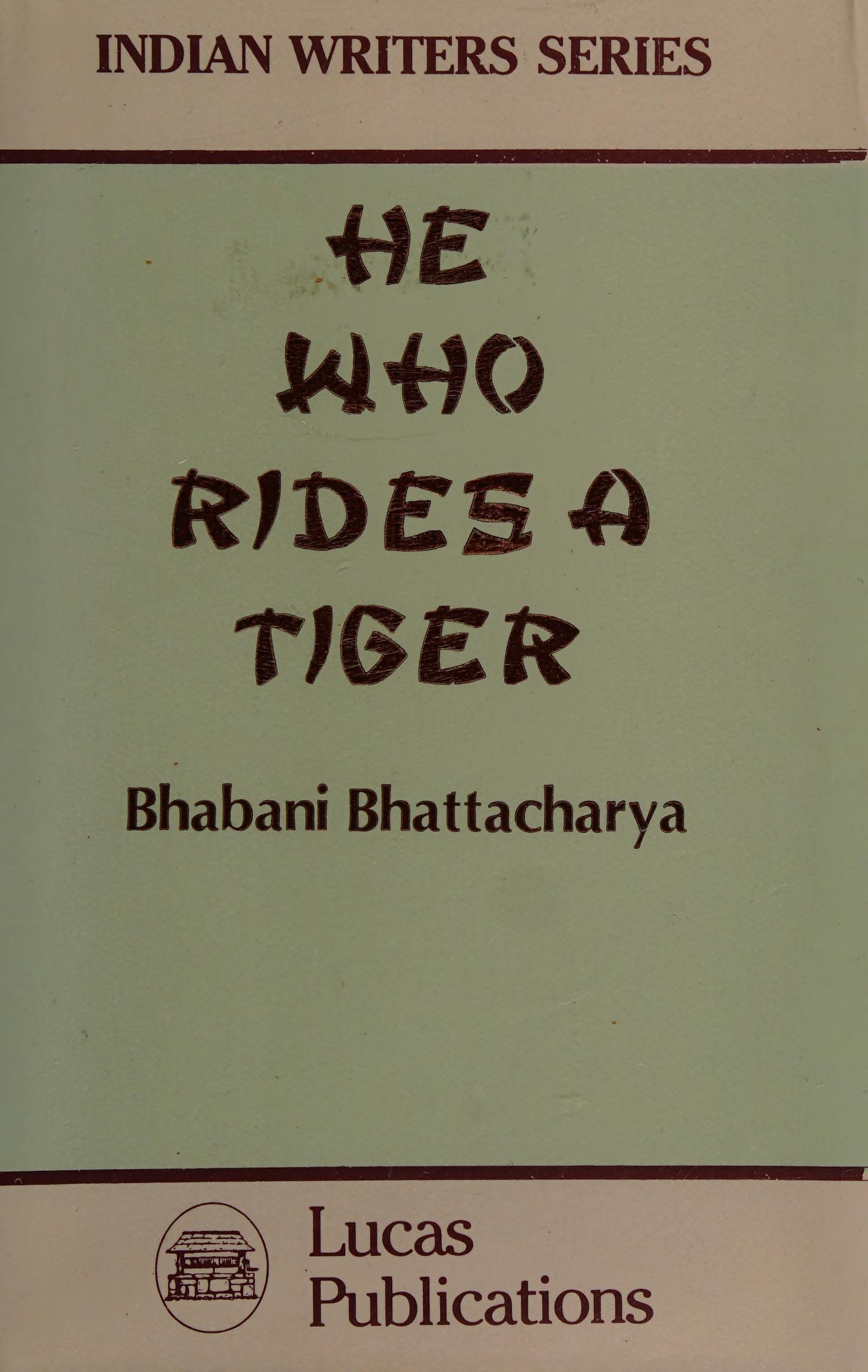
He Who Rides a Tiger
- Title:
- He Who Rides a Tiger
- Author:
- Bhabani Bhattacharya
- Date of Publication:
- 1954
- Keywords:
- Community Critique Ethics Gods & Spirits Holy People Omens & Visions Ritual
- Religions:
-
Hindu majorNon Affliated-Atheist major
- Locations:
-
India major
- Wikidata Entity ID:
- https://www.wikidata.org/wiki/Q135475079
- Open Library ID:
- https://openlibrary.org/works/OL22811490M
- Item Type:
- Text
- Item Image Format:
- image/jpeg
Keyword Engagements
- Community
- In Bhabani Bhattacharya’s He Who Rides a Tiger a false temple is constructed in honour of Shiva. The temple is supported by a group of wealthy patrons to whom the temple’s Brahmin priests minster. Kalo, a blacksmith and the novel’s protagonist, leads the temple, fraudulently presenting as a Brahmin priest; he is unhappy with the temple’s neglect of the starving population. The temple consumes resources that should be directed elsewhere. While maintaining his priestly pretence, Kalo diverts milk used in temple ritual to the starving people, weathering opposition from the temple authorities. In a dramatic final speech, Kalo reveals his identity and expresses solidarity with the masses.
- Critique
- In Bhabani Bhattacharya’s He Who Rides a Tiger, Hindu worship and the caste system that supports it is exposed for hypocrisy. Brahmin priests live comfortable lives supported by rich patrons who use their association with the temple to launder their public image; one temple supporter, for instance, traffics starving village girls – including Kalo’s daughter Chandra Lekha – into the brothels of Kolkata. Care for caste boundaries and ritual regulations facilitates social neglect. In one incident, the priests and temple authorities protest when Kalo, who fraudulently presents as a Brahmin priest, diverts to the needy the milk used in the ritual bath of the temple’s image of Shiva rather than pouring it into the River Ganges as the principles of the ritual dictate. Dedication to upholding rituals enables practitioners to ignore human misery and to forestall social action to improve conditions. The hypocrisy is ultimately too much for Kalo to bear; at the close of the novel, he reveals his identity and joins the people’s cause.
- Ethics
- In Bhabani Bhattacharya’s He Who Rides the Tiger, Kalo, the protagonist, has lived a dignified life as a skilled blacksmith in a Bengal village, but is reduced to penury in a time of famine. Forced to migrate to Kolkata to seek work, Kalo struggles to hitch a ride on the local train. Abused by the police and starving, Kalo steals a banana from a passenger; is caught; and is then sentenced to a lengthy term of hard labour in prison. Upon his release, Kalo eeks out an existence with a series of undignified and illegal occupations. While Kalo is working as a pander for a brothel owner, agents of Kalo’s employer traffic Chandra Lekha, Kalo’s own daughter, into one of the brothels. Angered by the suffering and exploitation the caste system facilitates, Kalo seeks revenge. He resolves to practise as a false priest, blasphemously desecrating the religion that upholds the exploitive system. Once he begins to enjoy the material comfort his fraud affords, Kalo must choose whether or not to marry his daughter to a temple patron to maintain the ruse. Kalo eventually follows his conscience, revealing his identity and freeing Chandra Lekha from the obligation to marry.
- Gods & Spirits
- The action of Bhabani Bhattacharya’s He Who Rides a Tiger pivots on the appearance of the god Shiva at an uninspiring site on the outskirts of Kolkata. The appearance was witnessed by Kalo, the protagonist, Chandra Lekha, Kalo’s daughter, and a local audience. After the image of Shiva appears, a temple is established at the site, which Kalo and his daughter run. The appearance, however, was fraudulent. Kalo prepared the site beforehand. He chiselled an image of Shiva from stone and buried it on top of some pulses. At the time of the appearance, Kalo watered the ground, the pulses sprouted, and the stone image was pushed up above ground. This staged miracle gives Kalo, a low born blacksmith masquerading as a Brahmin priest, the new authority.
- Holy People
- The protagonist of Bhabani Bhattacharya’s He Who Rides the Tiger is Kalo, a low caste blacksmith. Immiserated by famine, Kalo takes extraordinary action. Having learned about Hindu ritual from a jailed activist, a Brahmin by birth, Kalo impersonates a Hindu priest. He uses a simple trick to create a false miracle involving the appearance of Shiva; a temple is then. established at the site of the alleged miracle. The temple attracts rich benefactors, and Kalo and his daughter soon enjoy levels of material comfort they have never known before. In addition to a means of obtaining sustenance, Kalo undertakes the ruse as a form of revenge against an exploitive system underwritten by Hindu religion and the caste system. His resolve is tested as he seeks to maintain his standard of living while also remaining true to his conscience. Moved by the plight of the starving masses, Kalo risks his delicate position, attracting scrutiny by challenging the temple’s other priests. He diverts the milk used in temple rituals from being poured into the Ganges as tradition dictates and donates it instead to the poor. To the frustration of the temple priests, Kalo hires a poor blacksmith as temple caretaker and entertains the activist he befriended in prison. His biggest test is whether or not to marry his daughter to a temple patron. He ultimately chooses not to do so.
- Omens & Visions
- A dream of the coming of Shiva shapes the action of Bhabani Bhattacharya’s He Who Rides a Tiger. Kalo, the protagonist, and Chandra Lekha, his daughter, oversee the building of a temple following the appearance of Shiva at a site on the edge of Kolkata. The appearance of the god is witnessed by a large crowd of spectators who testify to its veracity. This audience had been secured in advance by Chandra Lekha in publicising a dream her father had enjoyed. In this dream, Shiva visited Kalo and said that he lay in a patch of waste ground and Kalo only needed to water the land for him to appear. The dream secures a large audience because Chandra Lekha is a striking messenger. She is not only arrestingly beautiful, but also mysteriously downcast. Having been trafficked into Kolkata by a brothel-owner, Chandra Lekha’s depression, as the reader understands, is a product of trauma, but to the witnesses and the growing temple community it is a mark of divinity. Chandra Lekha’s beauty and her sombre manner capture the community’s imagination.
- Ritual
- Bhabani Bhattacharya’s He Who Rides the Tiger is fascinated by ritual practice at the temple dedicated to Shiva around which the action of the novel turns. The fascination arises at least in part because Kalo, the protagonist, is masquerading as a Brahmin priest. The rites are recorded because they are rites that Kalo must imitate to substantiate his ruse. The novel records his fingering of the Brahminic thread that he wears and his close observation of the real priests he employs to utter mantra (that he cannot master himself). The novel details the ritual calendar of the temple: the aroti ceremony to welcome the god, the bhoga or food offering, the yagna ceremony performed on certain scared days when ghee was poured into a sacrificial fire accompanied by chanted mantra, and the milk baths of Shiva. Within the dynamic of the novel, the dedication to detail is ludicrous, given that the observance, insofar as it is performed by a blacksmith rather than a Brahmin, is blasphemous. Ritual is depicted as hollow, formulaic, and out of touch. This critique is focused on the waste of food and financial resources dedicated to ritual at a time of national crisis and famine. The novel not only insists that the food and money dedicated to ritual life would be better spent on the immiserated population, but also that attention to ritual formulae and traditions is a means of avoiding the pressing work of improving the material conditions of the masses. Ritual is a distraction.
Attribution
- Citation:
- "He Who Rides a Tiger", Mapping Religion in the Global Anglophone Novel (MaRGAN), https://ghjensen.github.io/margan/items/margan004.html
Rights
- Rights:
- Metadata and other content produced by the MaRGAN team for this website is free for teaching and research purposes, provided appropriate credit is given. See https://creativecommons.org/licenses/by/4.0/ for more information.
- Standardized Rights:
- https://creativecommons.org/licenses/by/4.0/