RECORD
The Secret Garden
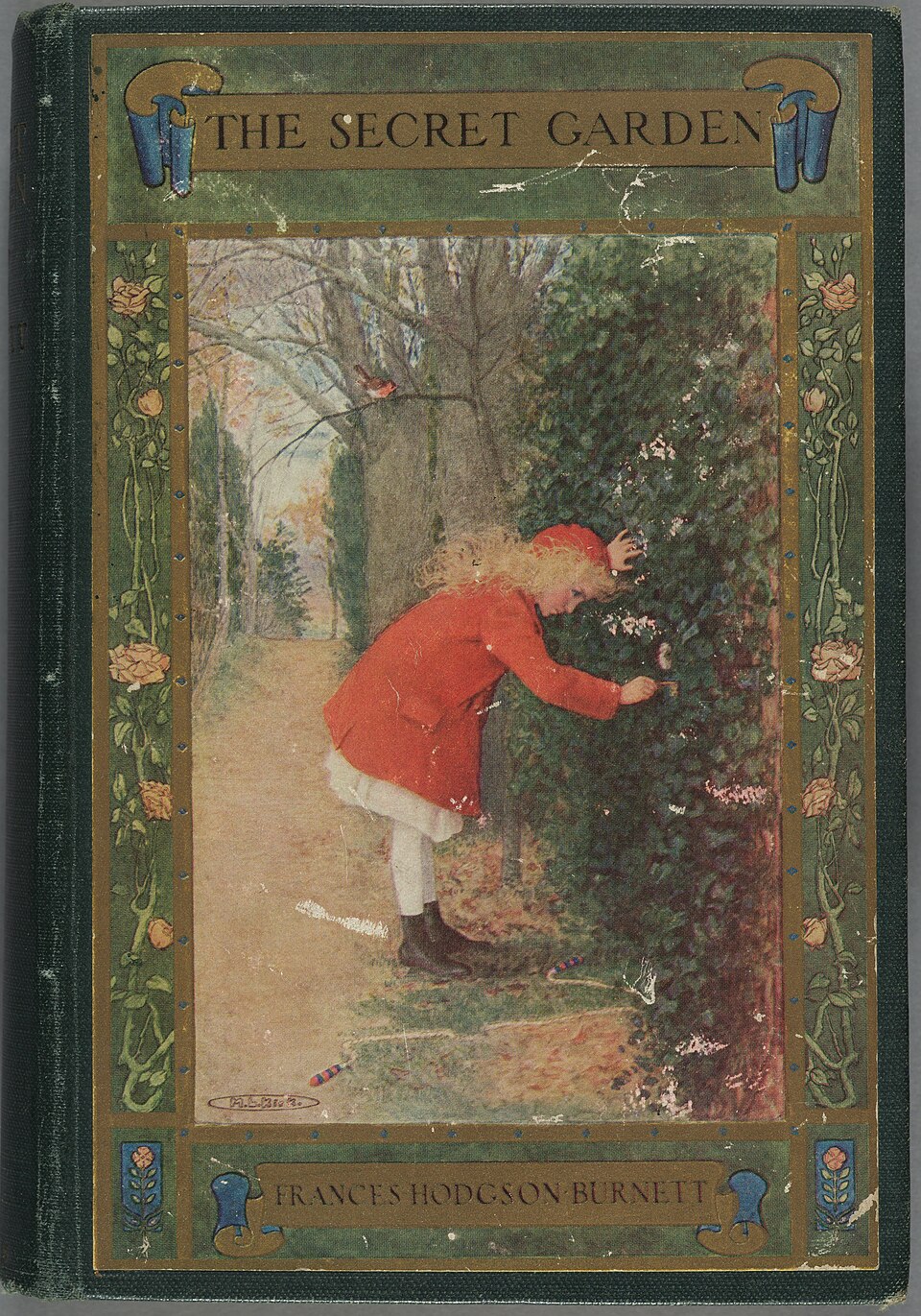
- Title:
- The Secret Garden
- Author:
- Frances Hodgson Burnett
- Date of Publication:
- 1911
- Description:
- The Secret Garden is a children's novel by Frances Hodgson Burnett first published in book form in 1911, after serialisation in The American Magazine. Set in England, it is seen as a classic of English children's literature. The American edition was published by the Frederick A. Stokes Company with illustrations by M. L. Kirk, and the British edition by Heinemann with illustrations by Charles Robinson. (Source: Wikipedia)
- Keywords:
- Enchantment Healing Nature Place Spirituality
- Religions:
-
Christianity-Protestant major
- Locations:
-
United Kingdom majorIndia minor
- Wikidata Entity ID:
- https://www.wikidata.org/wiki/Q472194
- Open Library ID:
- https://openlibrary.org/works/OL32350293M
- Item Type:
- Text
- Item Image Format:
- image/jpeg
Keyword Engagements
- Enchantment
- At the beginning of Frances Hodgson Burnett’s The Secret Garden, the main character, Mary Lennox is disenchanted, lonely, unpleasant and unmotivated. Across the novel, her outlook changes through her interactions with the landscape around her, particularly the titular garden and with wise characters who have a strong, positive relationship with the land (the Yorkshire moors) and with each other. Burnett refers to the source of Mary’s changing awareness as ‘Magic’ (see spirituality). The landscape itself reveals enchantment through the changes from winter (presented as bleak) to spring (presented as expansive and joyous) (see nature).
- Healing
- The primary plot driver for Frances Hodgson Burnett’s The Secret Garden is the healing of the main characters: Mary Lennox and Colin Craven. Mary is orphaned at the beginning of the novel; after both her parents dye in a cholera outbreak in India, she is sent to live with her uncle in Yorkshire. Mary is presented as a sickly, unhappy and unpleasant child at the beginning of the story and the novel follows her journey towards health and happiness, largely achieved through nutrition, outdoor exercise, growing sense of purpose (restoring a neglected garden [see nature] and challenging her cousin, Colin Craven, to follow her example) and interaction with kind and wise figures in the novel: Martha, Dickon and Susan Sowerby. Mary’s healing journey is echoed in Colin’s, who enters the book as an invalid expected to die before reaching adulthood. Following Mary, Colin also grows healthier, until he is able to walk again and ultimately declares himself entirely well. The children refer to the source of their healing as magic, a form of positive thinking largely derived from Christian Science.
- Nature
- Nature is a primary aspect of Frances Hodgson Burnett’s The Secret Garden. The plot centres around the healing of two children, through the search for, discovery off and restoration of the titular hidden garden. Mary is aligned with gardens from early in the text and the growth of plants in spring is central to the text and a robin is Mary’s first friend and helps her find the hidden garden. The child character Dickon is a Romantic Pan-figure (some readers detect a latent thread of the sexuality that often accompanies depictions of Pan, but Burnett pulls back from such depictions through emphasising the innocence of the children, especially Dickon). Dickon is accompanied by tamed wild creatures – a crow, a lamb and a fox – and has a deep affinity with the Yorkshire moor (presented at first as bleak and then as beautiful, enchanting, but far off space Mary can see but does not visit) and for the creatures that live there. He assists Mary and Colin in their work to restore the garden. Dickon represents Romantic notions of childhood as innocent, aligned with nature and containing wisdom lost to adults.
- Place
- In Frances Hodgson Burnett’s The Secret Garden, Mary cites Indian stories as a source for Magic and draws comparisons between Dickon and Indian snake charmers. Magic is described as a natural element that is subject to scientific experiments and positive thinking. Colin asks his companions for a song of thanks and joy and Dickon teaches them the Doxology. This is the most overt Christian moment in the text but Burnett does not suggest the children are worshiping a Christian God, but rather using a Christian prayer to express thanks to the Magic, a mysterious but natural force for growth and health in the world.
- Spirituality
- Mary cites Indian stories as a source for Magic and draws comparisons between Dickon and Indian snake charmers. Magic is described as a natural element that is subject to scientific experiments and positive thinking. Colin asks his companions for a song of thanks and joy and Dickon teaches them the Doxology. This is the most overt Christian moment in the text but Burnett does not suggest the children are worshiping a Christian God, but rather using a Christian prayer to express thanks to the Magic, a mysterious but natural force for growth and health in the world.
Attribution
- Citation:
- "The Secret Garden", Mapping Religion in the Global Anglophone Novel (MaRGAN), https://ghjensen.github.io/margan/items/margan006.html
Rights
- Rights:
- Metadata and other content produced by the MaRGAN team for this website is free for teaching and research purposes, provided appropriate credit is given. See https://creativecommons.org/licenses/by/4.0/ for more information.
- Standardized Rights:
- https://creativecommons.org/licenses/by/4.0/