RECORD
Armed with Madness
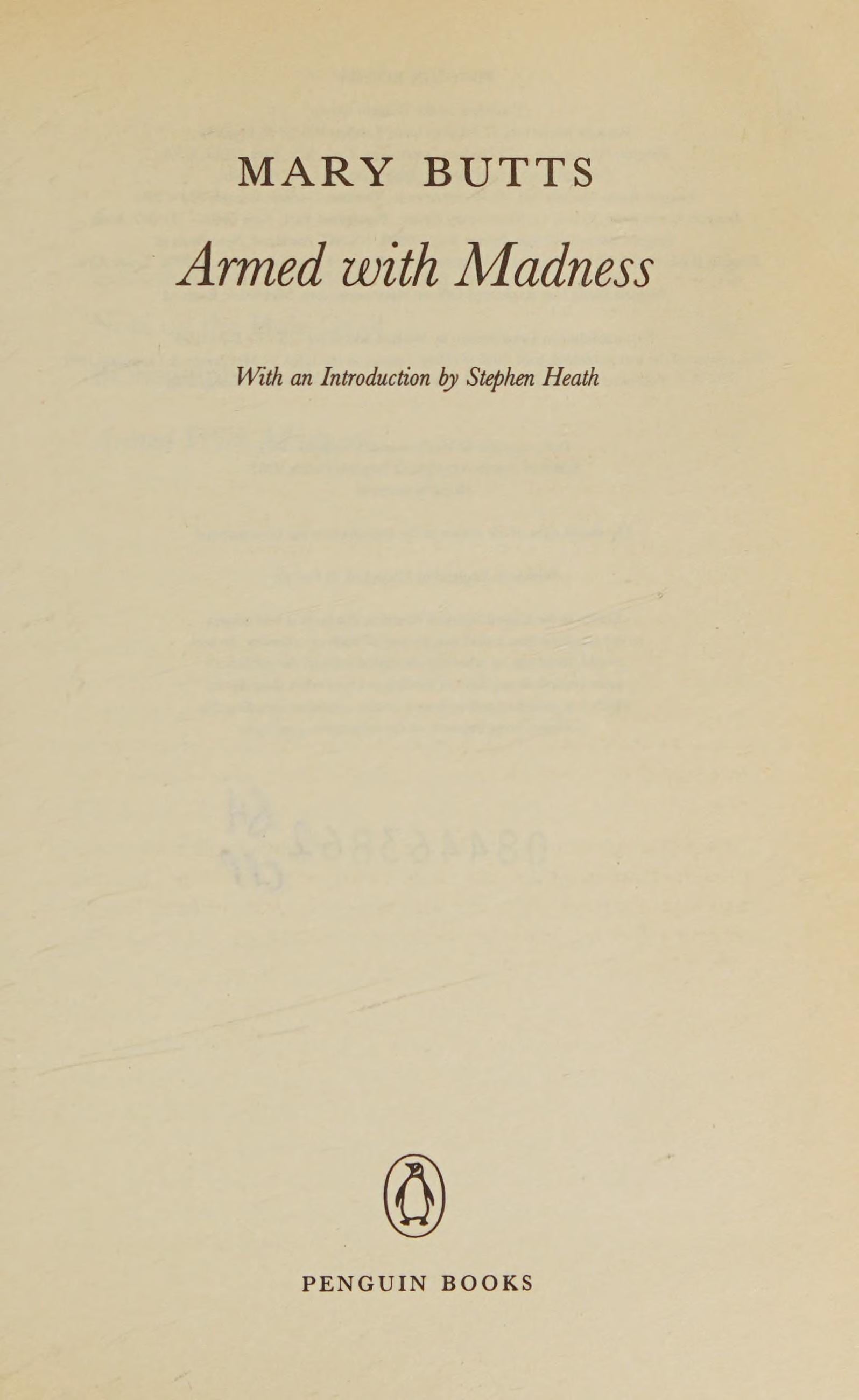
- Title:
- Armed with Madness
- Author:
- Mary Butts
- Date of Publication:
- 1928
- Description:
- Armed with Madness is a novel by Mary Butts first published in 1928 that incorporates Modernism and Psychoanalytical Criticism. (Source: Wikipedia)
- Keywords:
- Belief Enchantment Nature Place Ritual Sacrifice Thing
- Religions:
- Locations:
-
United Kingdom major
- Wikidata Entity ID:
- https://www.wikidata.org/wiki/Q13430524
- Open Library ID:
- https://openlibrary.org/works/OL7359130M
- Item Type:
- Text
- Item Image Format:
- image/jpeg
Keyword Engagements
- Belief
- Mary Butts’s Armed with Madness is set among a group of young bohemians and intellectuals in the aftermath of the First World War. The novel makes clear that the default for such men and women at this period is non-belief in God, at least insofar as He is understood in the organised Christian Church. Yet among the central family of characters—the Taverners—and especially in Scylla there persists an older form of faith in the sanctity of the land and in the mysterious forces (mana) that work through it. These forces and the form of worship they demand are alien and perhaps even hostile to outsiders. Chief among the latter is Dudley Carson who as a visitor from America represents the kind of materialistic and rationalistic culture that would deny the reality of the supernatural or spiritual.
- Enchantment
- Much of Mary Butts’s Armed with Madness takes place in and around Tollerdown in the West Country, the setting for the Taverners’s rural house. As in other works of fiction and non-fiction by Butts, her understanding of landscape is Pantheistic or animistic, suggesting a flow of nonhuman energy or the indwelling of spirits and gods through the natural world. Natural features such as woods and coastlines are peculiarly lively and strange as if animated by a divine energy, while ancient earthworks seem charged with the power of the pagan lives and rituals that have been enacted there. Butts was indebted to Jane Harrison’s concept of mana suggesting a wild and unpredictable force in nature. But Armed with Madness also conveys a strong sense of sacramentalism in nature drawing on her increasing attraction to Anglo-Catholic worship.
- Nature
- Much of Mary Butts’s Armed with Madness takes place in and around Tollerdown in the West Country, the setting for the Taverners’s rural house. As in other works of fiction and non-fiction by Butts, her understanding of landscape is Pantheistic or animistic, suggesting a flow of nonhuman energy or the indwelling of spirits and gods through the natural world. Natural features such as woods and coastlines are peculiarly lively and strange as if animated by a divine energy, while ancient earthworks seem charged with the power of the pagan lives and rituals that have been enacted there. Butts was indebted to Jane Harrison’s concept of mana suggesting a wild and unpredictable force in nature. But Armed with Madness also conveys a strong sense of sacramentalism in nature drawing on her increasing attraction to Anglo-Catholic worship.
- Place
- Mary Butts’s Armed with Madness presents a “deep insular” view of the West Country where families and traditions are long-lived and an ancient landscape featuring ancient monuments and prehistoric earthworks seems charged with primitive energies. Modernity is presented as a threat to the continuity of life in this ancient and sacred place. The younger generation of Taverners can no longer afford the upkeep of their country house. And the increasing encroachment of city-dwellers and international visitors (American and Russian) presents both an actual and symbolic threat to the organic ties between the native inhabitants and the land which is their birthright.
- Ritual
- The characters in Mary Butts’s Armed With Madness engage in and re-stage a series of rituals variously referencing Arthurian myths, occult and pagan practices and the lives of the Christian saints. The most significant of these rituals follows Felix, Clarence and Pictus’s supposed recovery of an ancient cup from a well. The characters embark on a quest to understand the mystery of this “Sanc-Grail” and despite its uncertain provenance undergo a ritual of sorts (“something like a ritual”) in the process. Other rituals performed in the novel suggest animistic beliefs and or pagan mystery rites. These often involve the love-triangle between Scylla, Pictus and Clarence and include Pictus’s fashioning and destruction of a wax effigy of Scylla and Scylla and Pictus’s sexual encounter under Gault Cliffs. Towards the end of the novel the American Carston saves Scylla from Clarence who would seem intent on sacrificing Scylla in a re-enactment of the martyrdom of Saint Sebastian.
- Sacrifice
- The martyrdom of Saint Sebastian is a recurring theme in the novel and is especially significant in relation to the love triangle between Clarence, Pictus and Scylla. Clarence makes a clay effigy of Pictus in order to shoot it with arrows before typing Scylla to the statue and preparing to shoot her instead. She survives after Carston arrives to interrupt the ritual.
- Thing
- The plot in Mary Butts’s Armed with Madness turns on Pictus’s discovery of ‘an odd cup of some greenish stone’ in a well. The characters embark on quest to understand the mystery of this Sanc-Grail and, although myriad more mundane origins are suggested for the cup (an altar cup, a Keltic chalice, an ashtray and an Indian poison cup) it holds an enduring fascination and seemingly independent power over the unfolding of events. Even following the revelation that Pictus planted the cup in the well in the first place the “logic” of the quest is worked out to the end. Other magical or animistic objects are suggested in the text including Clarence’s mazer, “a ring near to a magic ring”, and the effigy of Scylla that Pictus fashions out of wax and then destroys.
Attribution
- Citation:
- "Armed with Madness", Mapping Religion in the Global Anglophone Novel (MaRGAN), https://ghjensen.github.io/margan/items/margan007.html
Rights
- Rights:
- Metadata and other content produced by the MaRGAN team for this website is free for teaching and research purposes, provided appropriate credit is given. See https://creativecommons.org/licenses/by/4.0/ for more information.
- Standardized Rights:
- https://creativecommons.org/licenses/by/4.0/