RECORD
Sunlight on a Broken Column
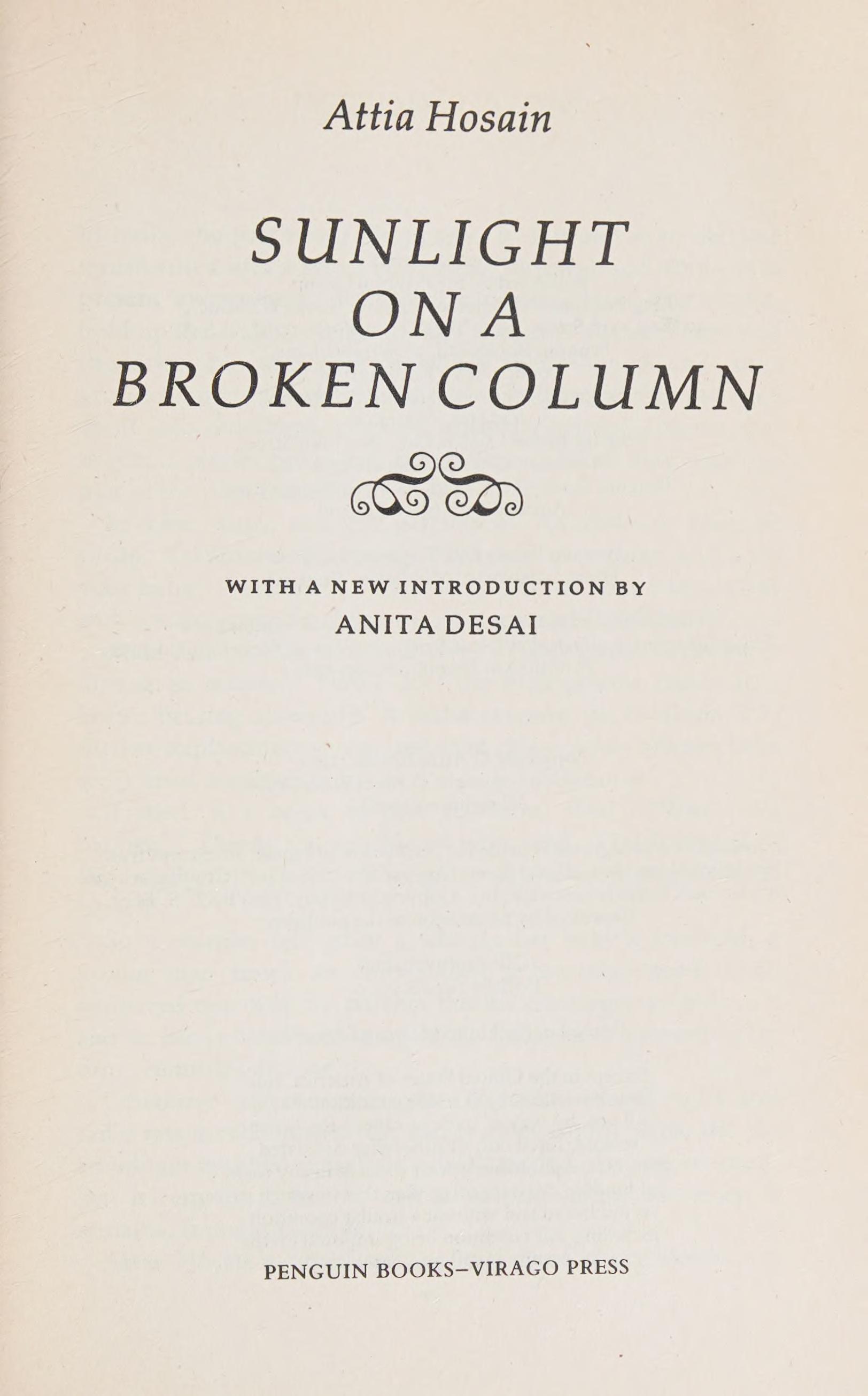
- Title:
- Sunlight on a Broken Column
- Author:
- Attia Hosain
- Date of Publication:
- 1961
- Description:
- Sunlight on a Broken Column is a novel by Attia Hosain, which was published in 1961. The novel, mainly set in Lucknow, is an autobiographical account by a fictional character called Laila, who is a 15-year-old orphaned daughter of a rich Muslim family of Taluqdars. It is a novel by a Muslim lady on the theme of Partition of India into India and Pakistan. (Source: Wikipedia)
- Keywords:
- Belief Community Critique Institutions Ritual
- Religions:
-
Hindu majorIslam-Sunni major
- Locations:
-
India major
- Wikidata Entity ID:
- https://www.wikidata.org/wiki/Q7640506
- Open Library ID:
- https://openlibrary.org/works/OL2211737M
- Item Type:
- Text
- Item Image Format:
- image/jpeg
Keyword Engagements
- Belief
- Tradition vs. modernity is a key theme in Sunlight on a Broken Column and while it does show the ingress of modern science into a traditional community, it also shows various characters across social classes and religious backgrounds espousing various shades of belief in the supernatural. Various shades of belief are depicted in the novel, from the puritanical assertions of Zahra and Zahid, to the syncretic beliefs of the household which gives alms to the holy beggar Kamli Shah, who cries out for alms in the name of both Allah and Bhagwan. There are also degrees of superstition such as when Jumman refuses to take his wife to the hospital preferring a reading of the Quran as a way of driving out the evil spirit possessing her which is later revealed to have been tetanus. In general, religion is ever-present in the background as a lot of the older characters such as Baba Jan, Ustanji, Hajjan Bibi and Laila’s aunts spend a lot of their time praying or repeating the name of Allah. Even the younger characters such as Laila and Zahra, Asad and Zahid often have impassioned arguments about religion.
- Community
- Sunlight on a Broken Column (SBC) is almost an elegy for a world and a way of life that had already disappeared by the time the novel was written. Through the eyes of the young orphaned girl Laila, we are offered a glimpse into the world of the aristocratic Muslim taluqdar (estate holder) families of Oudh. We see everyday life as shaped by an intricate set of codes, rituals and traditions. It is a strictly gender-segregated, patriarchal as well as hierarchical world, one in which izzat, or honour is the paramount value and family reputation is all-important. They have a sense of being a community, not just socially and culturally but also politically and view themselves as being responsible for and holding in trust the lives and prosperity of their tenants. They are shown to extend patronage towards extended family members and acquaintances and even former dancing girls (artists) who have fallen on hard times. In reality, of course, we realise that their privilege, elegant manners and feudal sense of responsibility and patronage is exploitative and unsustainable in light of the coming independence of India.
- Critique
- Though Sunlight on a Broken Column is a fond look at a way of life, community and a culture that is vanishing, it also critiques religion as well as the existing order. The religious and social hypocrisy is exposed in a number of places such as when Laila’s Uncle Mohsin, who is shown to be a debauched character himself, passes judgement on Jumman the washerman’s daughter though it is revealed that he himself had tried to seduce her earlier. Similarly, Laila’s cousin Zahra who reads the Quran five times a day and studies it for an hour every morning is shown to be a vain, frivolous and self-serving person, whereas her cousin Asad, who chafes at studying in the religious school and describes it as pushing him further away from belief is shown to be one of the most likeable and compassionate characters. We see that along with the professed religion and courtliness of many characters goes the exploitation which makes the power and privilege of their class possible.
- Institutions
- In Sunlight on a Broken Column, we see the old-world giving way to the new. It is a world that has been shaped by centuries of history, tradition and religion. In this world, the authority of the eldest male member, the head of the family is unquestioned, women live in the zenana (a screened off area of the home in which only very close relatives are allowed) and the pedigree (family, class, status) of a person matters more than their actual qualities. The institution of taluqdari, lends such power and authority to its constituents that Laila’s grandfather, Baba Jan is described as “…living the lives of so many people for them, reducing them to fearing automatons..” Custom dictates that women are to observe purdah (seclusion) from the outside (male) world, elders decide who their children will marry and children wordlessly obey whatever is decided for them by the elders of the family. Yet, we see that this world is already crumbling, as western education prompts many from the younger generation to question some of these customs and ways of doing things.
- Ritual
- Religion suffuses the text, and though in the background it keeps popping up as tradition, as culture and as everyday utterings and parts of speech. Rather prophetically, the novel opens with the long illness and subsequent death of Baba Jan, and we see the Quran being read for his health. After his death, his body is taken back to his village, and an all-night vigil and recitation of the Quran next to his dead body takes place, no food is cooked in the house for three days, and women from the barber’s family come to sing songs of mourning. In a similar vein, the rituals accompanying the marriages of Zahra and other family members are also described. There is also an extended and wonderful description of the rituals of Muharram (a day commemorating the martyrdom of the Prophets grandson), the reading of elegiac poetry, the lighting of lamps in the Imambaras (congregation halls) and mourning and chest-beating processions that mark the day.
Attribution
- Citation:
- "Sunlight on a Broken Column", Mapping Religion in the Global Anglophone Novel (MaRGAN), https://ghjensen.github.io/margan/items/margan012.html
Rights
- Rights:
- Metadata and other content produced by the MaRGAN team for this website is free for teaching and research purposes, provided appropriate credit is given. See https://creativecommons.org/licenses/by/4.0/ for more information.
- Standardized Rights:
- https://creativecommons.org/licenses/by/4.0/