RECORD
Moses, Man of the Mountain
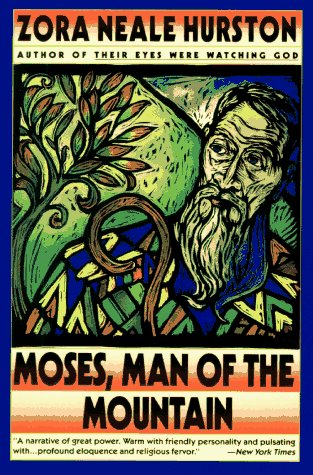
- Title:
- Moses, Man of the Mountain
- Author:
- Zora Neale Hurston
- Date of Publication:
- 1939
- Description:
- Moses, Man of the Mountain is a 1939 novel by African-American novelist and anthropologist Zora Neale Hurston. The novel rewrites the story of the Book of Exodus of Moses and the Israelites from an Afro-American perspective. The novel applies a number of different motifs and themes commonly addressed in African-American culture, subverting the Moses story. (Source: Wikipedia)
- Keywords:
- Community Gods & Spirits Holy People Place Sacred Texts
- Religions:
-
Judaism-Other majorPagan-Ancient major
- Locations:
-
United States major
- Wikidata Entity ID:
- https://www.wikidata.org/wiki/Q24255912
- Open Library ID:
- https://openlibrary.org/works/OL1890533M
- Item Type:
- Text
- Item Image Format:
- image/jpeg
Keyword Engagements
- Community
- Zora Neale Hurston’s "Moses, Man of the Mountain" retells the Biblical story of Moses. In contrast to the Bible, the novel presents Moses as born an Egyptian rather than a Hebrew, though rumors among both Egyptians and Hebrews raise uncertainty about this identity among the characters, including in Moses himself. The novel depicts the Hebrews suffering and rebelling in Egypt as they are made legal “aliens” and enslaved, and narrates the formation of a new Hebrew community as Moses leads them out of Egypt. When Moses leads the Hebrews out of Egypt, the novel emphasizes the presence of “mixed-blood people” among the Hebrews, undermining a narrowly ethno-national idea of a nation. Between his time as an Egyptian and his time as a leader of the Hebrews, Moses joins a third community when he becomes close with a Kenite man, Jethro, and marries his daughter, Zipporah, formally joining Jethro’s family and community. The novel’s “Introduction” frames Moses as a figure who transcends and even eclipses his persona in the “Christian world,” with his legend in “Asia and all the Near East” as well as “Africa” causing “some students have come to doubt if the Moses of the Christian concept is real” (vii).
- Gods & Spirits
- Zora Neale Hurston’s “Moses, Man of the Mountain” depicts images and communications from a god–variously called I AM WHAT I AM, the Voice, Lord, and the God of the mountain (and capitalized)–to Moses. Jethro, who becomes Moses’s father-in-law, first feels the call of this God and believed it was a call to bring Moses to this God. Moses goes to Sinai and talks with this god. This god directs Moses to lead the Hebrews out of Egypt. Moses confers with the god and claims he is visiting the plagues on the Egyptians, though the novel makes it clear that Moses can effect the plagues himself through his magical skills. The Egyptian gods are talked of by characters in the novel, but do not feature as characters in the same way as the God of Sinai.
- Holy People
- In Zora Neale Hurston’s “Moses, Man of the Mountain,” there are two primary sets of Holy People: on the one hand, the Egyptian priests and, on the other hand, Moses and his mentors, the Egyptian servant Mentu and Moses’s father-in-law, Jethro. In addition, Miriam, the Hebrew woman rumored to be Moses’s sister, is considered a prophetess among the Hebrews. The priests serve the Egyptian gods in temples and also report to the Pharaoh. The novel presents them as practitioners of “priestcraft”: they manipulate the lay Egyptians and even the court rulers through trickery. Flattered by Moses’s interest in them when he is a boy in Pharaoh's court, the Egyptian priests train him. Moses is also trained by Mentu, who appears to have vast magic knowledge grounded in close observation of nature, as well as knowledge of magic sources such as the Book of Thoth. With Mentu’s guidance, Moses eventually exceeds the Egyptian priests in real and illusory magic power, as becomes clear in contests between them. Jethro is a master magician and in imperfect communication with the god of Sinai, and he makes Moses promise that he, Moses, will realize Jethro’s dream of creating a nation of people for this god.
- Place
- In Zora Neale Hurston’s “Moses, Man of the Mountain” the titular mountain, Sinai, fascinates Moses. It is vividly described. Over time, Moses climbs higher and higher on the mountain, ultimately reaching higher than any other man, and coming into direct communication with the God of the mountain. The novel also features other key sites from the Biblical story of Exodus, such as the Red Sea.
- Sacred Texts
- Zora Neale Hurston’s “Moses, Man of the Mountain” features two main sacred texts within the body of the novel, and two in the novel’s framing. In the framing, the texts are 1) the Biblical book of Exodus, which tells the story of Moses retold here and 2) the The Sixth and Seventh Books of Moses, which Hurston describes in her “Introduction” to the novel as a widely-circulating text that claims to include “mystic symbols and seals and syllables said to have been used by Moses to work his wonders” (viii). Within the novel, the sacred texts are the Ten Commandments and the Book of Toth, a grimoire that Moses’s mentor Mentu tells him of, and which Moses goes in search of. These two sacred texts correspond to two versions of Moses that Hurston discusses in her “Introduction”: the “great law-giver” of Christian tradition (she does not mention Jewish tradition) and the magician revered in Africa and “wherever the children of Africa have been scattered by slavery” (viii).
Attribution
- Citation:
- "Moses, Man of the Mountain", Mapping Religion in the Global Anglophone Novel (MaRGAN), https://ghjensen.github.io/margan/items/margan013.html
Rights
- Rights:
- Metadata and other content produced by the MaRGAN team for this website is free for teaching and research purposes, provided appropriate credit is given. See https://creativecommons.org/licenses/by/4.0/ for more information.
- Standardized Rights:
- https://creativecommons.org/licenses/by/4.0/