RECORD
A Portrait of the Artist as a Young Man
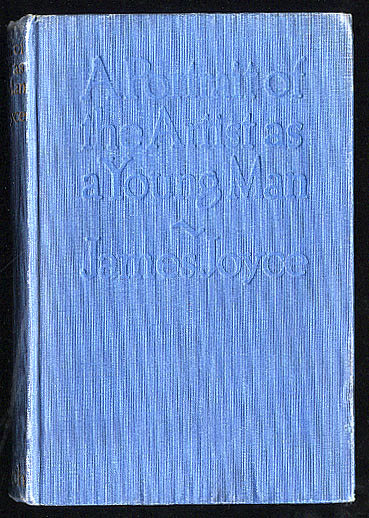
- Title:
- A Portrait of the Artist as a Young Man
- Author:
- James Joyce
- Date of Publication:
- 1916
- Description:
- A Portrait of the Artist as a Young Man is the second book and first novel of Irish writer James Joyce, published in 1916. A Künstlerroman written in a modernist style, it traces the religious and intellectual awakening of young Stephen Dedalus, Joyce's fictional alter ego, whose surname alludes to Daedalus, Greek mythology's consummate craftsman. Stephen questions and rebels against the Catholic and Irish conventions under which he has grown, culminating in his self-exile from Ireland to Europe. The work uses techniques that Joyce developed more fully in Ulysses (1922) and Finnegans Wake (1939). (Source: Wikipedia)
- Keywords:
- Arts Body Critique Holy People Institutions
- Religions:
- Locations:
-
Ireland major
- Wikidata Entity ID:
- https://www.wikidata.org/wiki/Q465360
- Open Library ID:
- https://openlibrary.org/works/OL58991473M
- Item Type:
- Text
- Item Image Format:
- image/jpeg
Keyword Engagements
- Arts
- A Portrait of the Artist as a Young Man by James Joyce values art over ascetic religiosity. While studying at Belvedere College, the novel’s protagonist, Stephen Dedalus, considers joining Catholic priesthood but finds himself repelled by the routine-based lifestyle of the clergy. He instead chooses to pursue art; a decision he reaches upon seeing a girl wading at a beach. Stephen is so enraptured by her otherworldly beauty that he chooses a life of aestheticism over ascetism, wanting to capture the girl’s beauty through artistic means. While traditional religiosity has failed to offer Stephen sustained spiritual enrichment, his experience of the girl’s beauty fills him with an ecstatic joy that carries its own religious feeling. At university, Stephen attempts to forge his own aesthetic theory and ultimately decides to leave Ireland to escape the paralysis of the nation’s spiritual life, seeking a more artistically inclined environment in Paris.
- Body
- The body and soul are initially imagined as a hierarchy in James Joyce’s A Portrait of the Artist as a Young Man. Young Stephen Dedalus is told by Jesuit teachers that the soul is fundamentally more important than all worldly things. The body and its sensual desires are thus figured by Stephen as crude and animal-like, leading him to disavow his own bodily pleasures and urges to lead an ascetic life. He abandons his ascetism, however, as his faith in the Catholic church is challenged by the Jesuits’ hypocrisy. In his doubt, Stephen is seduced by the allure of aesthetic beauty and finds himself less opposed to the bodily senses needed to experience said beauty. Turning away from Catholicism and toward aestheticism, Stephen’s view of the body becomes less antagonistic, marking an important change in his journey as a budding artist.
- Critique
- James Joyce’s A Portrait of the Artist as a Young Man criticises Catholic faith through its believers. The novel’s protagonist, Stephen Dedalus, attends different Jesuit colleges and finds in all of them priests who are cruel, hypocritical, and inclined to corporeal punishment. Stephen grows distrustful of the clergy but remains a cautious believer. When his school then attends a religious retreat, Stephen is victim to the passionate preaching of Father Arnall, who for pages on end describes in great, vivid detail the divine punishments awaiting sinners upon death. Terrified for his mortal soul, Stephen adopts an ascetic lifestyle and later considers joining the clergy, but years of studying underneath the two-faced, cruel, and at times violent Jesuits ultimately disillusions Stephen of their religious dogma. Doubting the Catholic faith, Stephen finds meaning in the beauty of art instead, choosing an aesthetic life over the oppressive, fear-based tyranny of his childhood religion.
- Holy People
- James Joyce’s A Portrait of the Artist as a Young Man brims with allegedly holy people. Young Stephen Dedalus encounters several of them throughout his education, starting at the Jesuit-run Clongowes Wood College. Here Dedalus is witness to the cruelty and deception of various priests: the easily angered Father Arnall, who forces Stephen’s friend, Fleming, to kneel on the classroom floor; the sadistic Father Dolan, who flogs Fleming for his supposed idleness and Stephen for allegedly breaking his own glasses; the seemingly kind rector Father Conmee, who assures Stephen that the flogging incident will not be repeated, only to later reveal that he considered the incident an amusing joke. Stephen grows increasingly sceptical of clergymen and their decidedly unholy behaviour. Upon enrolling at Belvedere College, however, he finds himself scared into submission by their vivid descriptions of hell and damnation. Becoming deeply devout, Stephen considers joining the clergy himself, only to ultimately choose his artistic ambitions over the ascetic life of priesthood, having become disillusioned by their hypocritical behaviours.
- Institutions
- In James Joyce’s A Portrait of the Artist as a Young Man, educational institutions gain their authority through religious fears. The novel’s protagonist, Stephen Dedalus, attends three Jesuit colleges, all of which appear to him as hypocritical and suffocating. At Clongowes Wood College, young Stephen finds himself at the mercy of easily angered and often sadistic priests who flog students perceived to be idle or troublesome. Stephen himself is unjustly punished by these priests but otherwise avoids punishment by quiet obedience. At Belvedere College, he is terrorised by promises of eternal damnation to sinners who do not repent, causing him to adopt an ascetic lifestyle and consider life as a priest. At University College, Stephen is encouraged by a friend to dismiss his religious doubts in favour of his mother’s wish for him to attend Easter services. There is in each institution a religious presence, among both students and teachers, that advocates for conformity over free thinking. This atmosphere stifles Stephen’s artistic spirit, and he leaves university for Paris.
Attribution
- Citation:
- "A Portrait of the Artist as a Young Man", Mapping Religion in the Global Anglophone Novel (MaRGAN), https://ghjensen.github.io/margan/items/margan015.html
Rights
- Rights:
- Metadata and other content produced by the MaRGAN team for this website is free for teaching and research purposes, provided appropriate credit is given. See https://creativecommons.org/licenses/by/4.0/ for more information.
- Standardized Rights:
- https://creativecommons.org/licenses/by/4.0/