RECORD
Their Eyes Were Watching God
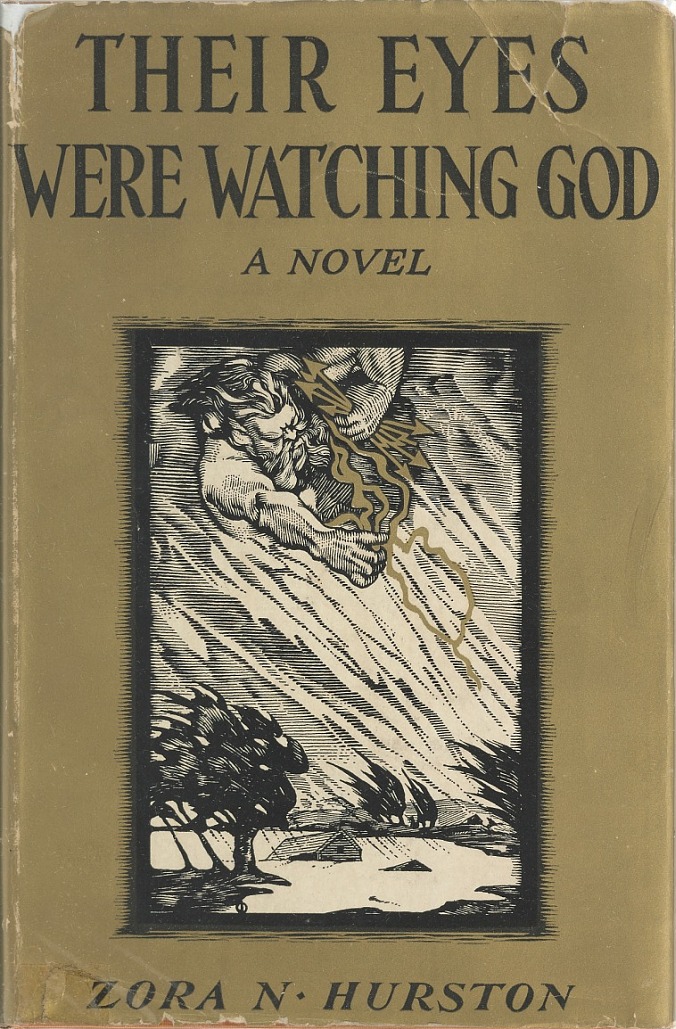
- Title:
- Their Eyes Were Watching God
- Author:
- Zora Neale Hurston
- Date of Publication:
- 1937
- Description:
- Their Eyes Were Watching God is a 1937 novel by American writer Zora Neale Hurston. It is considered a classic of the Harlem Renaissance and Hurston's best-known work. The novel explores protagonist Janie Crawford's "ripening from a vibrant, but voiceless, teenage girl into a woman with her finger on the trigger of her own destiny." (Source: Wikipedia)
- Keywords:
- Sacred Texts Critique Apocalypse Nature Ritual
- Religions:
-
Christianity-Protestant major
- Locations:
-
United States major
- Wikidata Entity ID:
- https://www.wikidata.org/wiki/Q1476619
- Open Library ID:
- https://openlibrary.org/works/OL8580015M
- Item Type:
- Text
- Item Image Format:
- image/jpeg
Keyword Engagements
- Sacred Texts
- Early in the novel, Zora Neale Hurston’s "Their Eyes Were Watching God" frames itself as a religious text when the novel’s narrator and protagonist, Janie, invokes her grandmother Nanny’s wish to have been a preacher with a pulpit (16). In telling her story to her friend Phoeby, Janie is preaching a kind of sermon herself, fulfilling Nanny’s wish. Moreover, at times the narration uses folkloristic and Biblical language that makes the novel sound variously like a creation story, a parable, or other traditional or sacred text.
- Critique
- Zora Neale Hurston’s “Their Eyes Were Watching God” critiques Christianity and patriarchal culture more broadly from what commentators such as Alice Walker and Rev. Katie G. Cannon call a Womanist perspective. Janie’s experience of ecstasy under the pear tree as a girl and the model of marriage this gives her offers an alternative to Nanny’s, Logan Killick’s, and Jody’s patriarchal understandings of marriage, even before the novel depicts that patriarchal version. At crucial moments in Janie’s story, springtime imagery returns in a way to continues to offer an alternative value system and affect to social and religious conventions, as when Janie, “sent her face to Joe’s funeral, and herself went rollicking with the springtime across the world” (89). Janie’s life story as she tells it to Phoeby constitutes a critique of other people’s stories about her, including those of town gossips and stories offered at her trial that would condemn her for shooting Tea Cake. But Janie’s story is also more than a critique because it offers fully imagined alternatives.
- Apocalypse
- At a climax in Zora Neale Hurston’s “Their Eyes Were Watching God,” a hurricane hits the Everglades where Janie and Tea Cake are living and working picking beans. It features apocalyptic imagery of death, afterlife, and chaos among nature, including people and animals. This scene also features the novel’s title, which describes the people sheltering and staring out into the darkness “watching God” (160). After the hurricane hits, the folkloristic image of God or the Watcher (“Him-with-th-square-toes”) had “gone back to his house” and his “pale white horse had galloped over the waters and thundered over the land,” suggesting the “pale horse” of the apocalypse of Revelations (168).
- Nature
- Nature plays significant roles in Zora Neale Hurston’s “Their Eyes Were Watching God.” Janie’s experience of it suggests it holds spiritual meaning, as when the blossoming pear tree “called her to come and gaze on a mystery” (10). Janie’s early experience gazing at this tree gives her a model of ecstatic relations among plants and insects that forms a resource for her critique of patriarchal marriage: “So this was a marriage! She had been summoned to behold a revelation. Then Janie felt a pain remorseless sweet that left her limp and languid” (11). The climax of the novel features a hurricane that leads to Tea Cake contracting rabies, and Janie having to shoot him. The violent hurricane imagery contrasts with the beautiful, ecstatic pear tree scene, but both feature the presence of mystery and divinity.
- Ritual
- Zora Neale Hurston’s “Their Eyes Were Watching God” features rite-of-passage rituals among characters, including Janie’s two marriages and her second husband Jody’s funeral. It also features a mock funeral for Matt Bonner’s mule, which had become a local celebrity of sorts after Joe Stark bought him to “free” him from mistreatment. After the people leave the mule’s carcass behind in the swamp, this mock funeral is followed by a funeral ceremony among the buzzards, whose call-and-response service for the mule is given in the text (62). These rituals feature doubling that connects to critique: for example, the eerie solemnity of the buzzard’s funeral contrasts with the mockery of the people’s funeral for the mule, implying the latter’s unnatural cruelty.
Attribution
- Citation:
- "Their Eyes Were Watching God", Mapping Religion in the Global Anglophone Novel (MaRGAN), https://ghjensen.github.io/margan/items/margan014.html
Rights
- Rights:
- Metadata and other content produced by the MaRGAN team for this website is free for teaching and research purposes, provided appropriate credit is given. See https://creativecommons.org/licenses/by/4.0/ for more information.
- Standardized Rights:
- https://creativecommons.org/licenses/by/4.0/