RECORD
The Guide
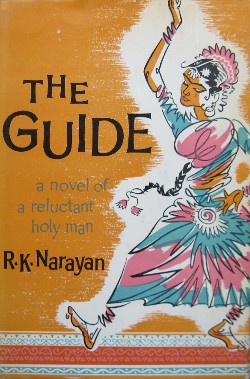
- Title:
- The Guide
- Author:
- R.K. Narayan
- Date of Publication:
- 1958
- Description:
- The Guide is a 1958 novel written in English by the Indian author R. K. Narayan. Like most of his works, the events of this novel take place in Malgudi, a fictional town in South India. The novel describes the transformation of the protagonist, Raju, from a tour guide to a spiritual guide and then one of the greatest holy men of India. (Source: Wikipedia)
- Keywords:
- Arts Critique Holy People Performance Sacrifice
- Religions:
-
Hindu major
- Locations:
-
India major
- Wikidata Entity ID:
- https://www.wikidata.org/wiki/Q7738453
- Open Library ID:
- https://openlibrary.org/works/OL17924003M
- Item Type:
- Text
- Item Image Format:
- image/jpeg
Keyword Engagements
- Arts
- Dancing in R. K. Narayan’s novel The Guide serves as a substitute for religion. Its protagonist, Raju, is enchanted by the traditional dance performed by Rosie – a married woman whom he loves. Despite his lack of religiosity, Raju is moved by an art rooted in religious rituals, and he goes on to nurture Rosie’s dreams of performing for live audiences. Her dancing quickly becomes famous throughout India, and the popularity of her art implies a need for some sort of religious experience – even if Rosie exclusively performs at secular venues, thus cutting her art off from its original context. As Rosie’s career skyrockets, Raju becomes increasingly more controlling of her, exploiting her talents for profit and status until finally he is imprisoned for forging her signature. Upon release, Raju accidentally becomes the spiritual guide to a local community – a role which he accepts with some hesitation. As his deception goes on, he leads the locals through sermons using song and clapping, echoing the bodily and musical arts of Rosie, albeit in an explicitly religious setting with a (somewhat) disingenuous performer.
- Critique
- The Guide by R. K. Narayan offers an ambiguous critique of Hinduism in India. The novel switches between a past narrative of its protagonist, Raju, and a present narrative of the holy man he is perceived to be. In the former narrative, Raju is guided by lust and greed and imprisoned for forgery. In the latter narrative, a recently released Raju stumbles into the role of spiritual guide to the local community of a temple he just so happens to inhabit. His motivations are selfish, thus making his followers’ worship of him seem ignorant and superstitious; they mistake Raju for a sadhu, expecting him to perform miracles such as conjuring rain in the middle of a drought. The critique is complicated by the fact that Raju’s deception appears to benefit the locals, and his acceptance of his role by the novel’s end makes it seem as if he has become what he pretended to be. The novel cuts off, however, before the arrival of rain (or lack thereof) can confirm or deny his holiness.
- Holy People
- R. K. Narayan’s novel The Guide features the fraudulent Raju as he accidentally – or by fate – becomes a holy man in South India. The narrative switches between Raju’s background of adultery, greed, and deception (told in the first person) and his present situation of being perceived as a sadhu by a local community (told in the third person). Raju stumbles into the role accidentally and stays in it for selfish reasons, although the role tempers his selfishness as he gives back to the community. However, Raju eventually finds himself trapped in the role as miscommunication and a drought leads the locals into believing that he will fast until the rains arrive. Raju begrudgingly – then later more enthusiastically – accepts this. It is ambiguous whether Raju’s transformation is a genuine one or a deception gone too far; him playing the part of sadhu appears to benefit the locals, but his motivations are primarily selfish, and his proper acceptance of his role comes very late in the narrative. The novel offers no clear interpretation of Raju’s perceived holiness; it ends with Raju collapsing after allegedly sensing the arrival of rain.
- Performance
- R. K. Narayan’s novel The Guide walks an uneasy line between genuine religious performance and hypocrisy. In the past narrative, the protagonist Raju performs religiosity under the watchful gaze of his father, only to later exploit the ritual dance of his lover, Rosie, whose signature he forges. In the present-day narrative, Raju is released from prison and takes refuge in a Hindu temple, only to be mistaken for a spiritual guide. Instead of coming clean, Raju performs the role of sadhu, solving the local’s everyday problems and offering spiritual guidance. He holds sermons using religious songs, texts, and fables, much like a proper sadhu might. However, it is all laced with a sense of hypocrisy and ignorance, as Raju’s performance is not genuine, but an act for his own benefit. He is ultimately trapped in his role as a drought requires him to fast in the hopes of rain, although the novel cuts off before the rain may (or may not) arrive. Before the end, however, Raju accepts his role enthusiastically, perhaps implying that he has become the sadhu he pretended to be.
- Sacrifice
- Sacrifice in R. K. Narayan’s novel The Guide is mostly done unwillingly. The protagonist, Raju, spends his life primarily motivated by lust and greed, only to find himself mistaken for a sadhu. He accepts the role for the easy access to food and adoration it brings, but his greed is tempered over time, and he redistributes the locals’ gifts back to them, sacrificing his own goods for the community. His transformation, however, is tested as a drought makes life more difficult for the locals. Violent conflicts rise beyond Raju’s powers of diplomacy, and miscommunication leads the locals into thinking that Raju will fast until the rains arrive. Raju tries to cheat his fast in private but fails. Like a sacrificial lamb, Raju must step into the ascetic lifestyle he has only partially adopted. He accepts his fate, however, and on the eleventh day of his fast he stands in the dried-out river and announces the arrival of rain before collapsing. It is ambiguous whether the rain actually arrives and whether Raju survives the fast, but his sacrifice as a religious figure does stop the violence caused by the drought.
Attribution
- Citation:
- "The Guide", Mapping Religion in the Global Anglophone Novel (MaRGAN), https://ghjensen.github.io/margan/items/margan024.html
Rights
- Rights:
- Metadata and other content produced by the MaRGAN team for this website is free for teaching and research purposes, provided appropriate credit is given. See https://creativecommons.org/licenses/by/4.0/ for more information.
- Standardized Rights:
- https://creativecommons.org/licenses/by/4.0/