RECORD
The Ballad of Peckham Rye
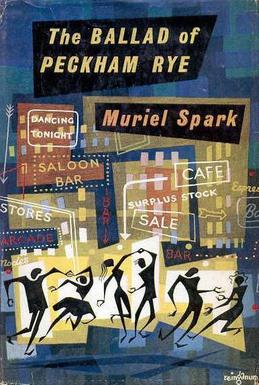
- Title:
- The Ballad of Peckham Rye
- Author:
- Muriel Spark
- Date of Publication:
- 1960
- Description:
- The Ballad of Peckham Rye is a novel written in 1960 by the British author Muriel Spark. (Source: Wikipedia)
- Keywords:
- Belief Critique Enchantment Community Ethics Supernatural
- Religions:
- Locations:
-
United Kingdom major
- Wikidata Entity ID:
- https://www.wikidata.org/wiki/Q31179
- Open Library ID:
- https://openlibrary.org/works/OL5796061M
- Item Type:
- Text
- Item Image Format:
- image/jpeg
Keyword Engagements
- Belief
- In Muriel Spark’s The Ballad of Peckham Rye, Dougal Douglas or Douglas Dougal enters Peckham as a new employee of Meadows, Meade & Grindley. He is a university arts graduate from Edinburgh, and he is tasked with addressing absenteeism in the factory; for this he must become intimately involved in the community. Dougal Douglas – as some of the characters observe – has what appears to be small horns on his head. His appearance in Peckham is marked by an increase in violence, climaxing in Mr Druce’s murder of his lover Merle Coverdale. Dougal manipulates everyone with whom he comes into contact, changing his behaviour and style of presentation to help him. He uses the tricks that characterise the devil. However, Peckham is a community without belief. The factory has usurped the role of religion in the lives of the workers; it organises their working and social lives, looks after them in old age and death through pensions and burial scheme, and is keen to be involved in their family lives, too, through the advent of a marriage scheme. The Peckham community are simply unable to see Dougal for what he is due to their lack of belief, which renders them naïve.
- Critique
- Muriel Spark’s The Ballad of Peckham Rye critiques the secular, disenchanted society of post-war Britain. In Peckham, the church appears at the outset of the novel as a venue for the failed married service of Humphrey and Dixie, but there is little to no churchgoing amongst the local population. This society, as Spark depicts it, is aimless and goals; the characters are devoid of higher meaning in their lives: Mr Druce has an adulterous affair with Merle Coverdale; Humphrey, Trevor and Collie fight while Beauty, Dixie and Elaine look on; Beauty is narcissistically obsessed with her own appearance. When Dougal Douglas or Douglas Dougal arrives, the mysterious, enigmatic figure at the centre of the novel, and brings with him the possibility of real evil, the figures are defenceless. Dougal’s pressure figures in Mr Druce’s murder of Merle, Humphrey and Dixie’s failed wedding, Beauty and Trevor break up.
- Enchantment
- Muriel Spark’s The Ballad of Peckham Rye is set in a typical post-war community of factory workers and managers. It is a profoundly disenchanted world, one in which religion is largely absent. Mr Druce and Mr Weedin employ Dougal Douglas or Douglas Dougal to engage in research on absenteeism; he must engage closely with the workers and help the factory develop its pastoral role. The factory guides employees through life, offering training, recreation, pension, burial and perhaps marriage schemes in the future too. Dougal sounds like a secular priest: the factory, a secular church. Dougal is an enigmatic figure, a trained actor who shifts shape as the situation demands; he has small bumps on his head, which might be the beginnings or remnants of horns. There is something devilish about him. His presence in town brings out or is followed by expressions of evil such as Mr Druce’s murder of Merle. Peckham residents do not know what to make of Dougal. He is enigmatic and mysterious, dangerous and alluring at a time when the faculty wants to organise rationally and institutionally every element of the workers’ lives. The chaos of the novel follows from the introduction of this enchanted figure into a disenchanted world.
- Community
- In Muriel Spark’s The Ballad of Peckham Rye, Peckham is populated by a close-knit, working and lower-middle class community of factory workers and administrators from the post-World War II era in Britain. Most residents work at Meadows, Meade & Grindley, and social life revolves around the events the factory puts and the pubs and living rooms that surround the factory. Mr Druce and Mr Weedin hire Dougal Douglas to oversee absenteeism and to develop the factory’s programmes for organising the social life of the workers. The factory is the central element in the lives of the community. The novel does not depict the community prior to Dougal’s arrival, but once he appears violence follows: Humphrey, Trevor and Collie fight while Beauty, Dixie and Elaine look on; Mr Druce murders Merle Coverdale with whom he has having an affair. The novel does not make it clear whether these expressions of violence are instigated by Dougal or whether his actions merely reveal the latent darkness in this society.
- Ethics
- Muriel Spark’s The Ballad of Peckham Rye confronts the problem of evil. Dougal Douglas or Douglas Dougal, a new employee at a factory in Peckham, is an outsider, an educated arts man. He also appears to have small horns upon his head and his arrival in Peckham is marked by an increase in violence and adultery culminating in Mr Druce’s murder of Merle Coverdale. The novel oscillates between presenting this evil as stage-managed by Dougal and a feature of the community that Dougal merely exposed. The novel is nevertheless clear both that evil is present in contemporary society – as its deadpan depiction of Mr Druce’s actions make clear – and that secular society is naïve and ultimately unable to deal with evil. The factory, in Peckham, has taken on many of the functions of organised religion: organising social lives, taking care of people in death and old age, even considering starting a marriage scheme to support families. This institution, however, cannot help their workers confront evil; in fact, the institution invites evil in the form Dougal into the community by offering him a job.
- Supernatural
- In Muriel Spark’s The Ballad of Peckham Rye, Dougal Douglas or Douglas Dougal oscillates between a regular and a supernatural figure. On the one hand, he is an employee of the factory; he is a university graduate brought in by Mr Weedin and Mr Druce to study absenteeism. He engages with the Peckham community in entirely naturalistic ways, getting to know them, developing relationships, adapting to different groups’ ways of speaking. On the other, he is a mysterious and enigmatic presence who seemingly transforms his appearance and presentation as he moves from group to group – in his job interview he shifts from presenting as a professor and then a television presenter – he has two small growths on his head that could be taken to be horns. His appearance in Peckham is accompanied by an increase in violence culminating in Mr Weedin murdering his lover, Merle Coverdale. The novel is invested in presenting Dougal as a mere man: the outpouring of evil in Peckham was something latent in society and not introduced by Dougal, and yet the novel also suggests that Dougal is a Satanic figure, an eruption of the supernatural into the everyday. Often, the novel invokes this supernatural status playfully: Dougal, for instance, asks other characters to touch his horns.
Attribution
- Citation:
- "The Ballad of Peckham Rye", Mapping Religion in the Global Anglophone Novel (MaRGAN), https://ghjensen.github.io/margan/items/margan033.html
Rights
- Rights:
- Metadata and other content produced by the MaRGAN team for this website is free for teaching and research purposes, provided appropriate credit is given. See https://creativecommons.org/licenses/by/4.0/ for more information.
- Standardized Rights:
- https://creativecommons.org/licenses/by/4.0/