RECORD
The Undying Fire
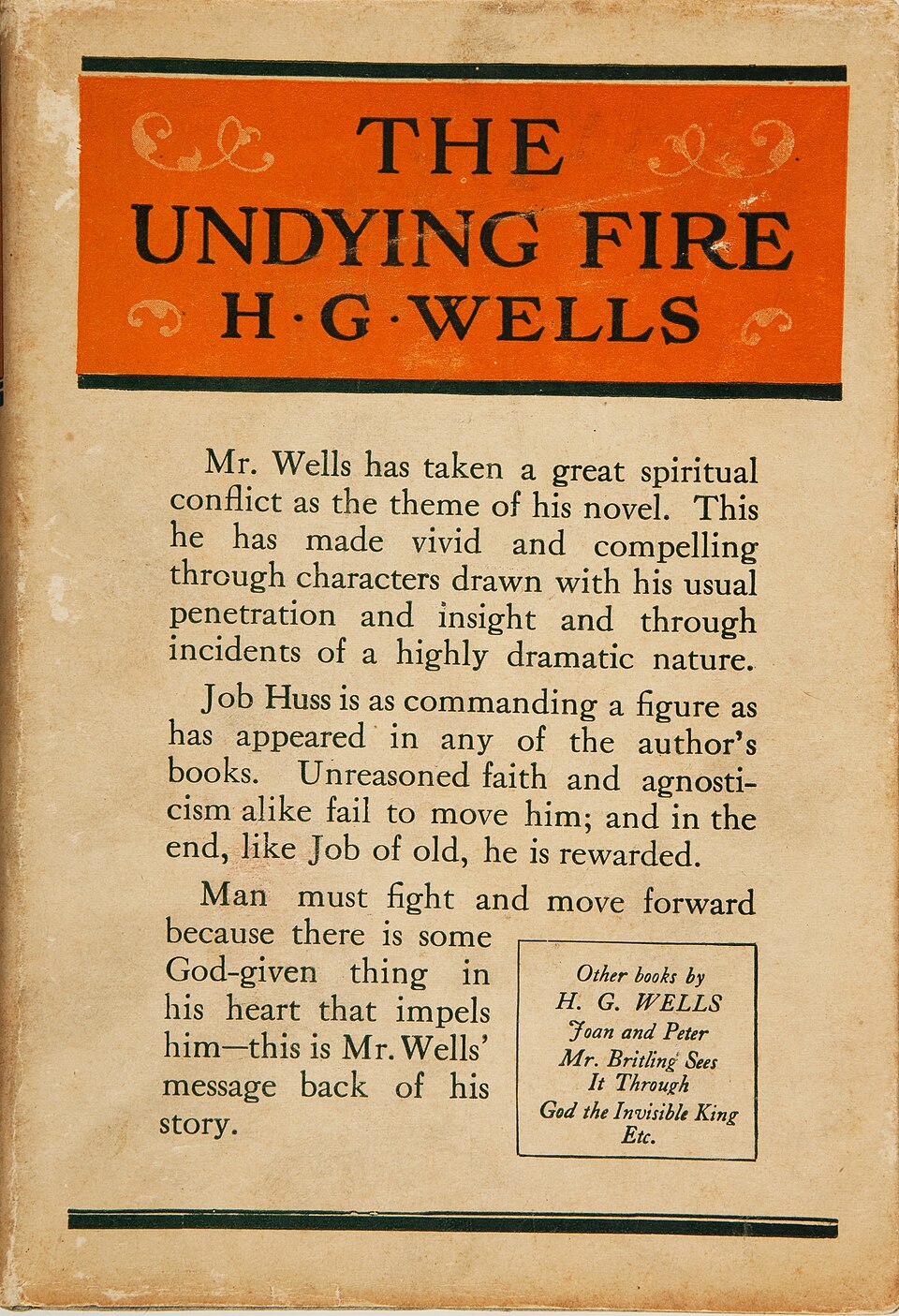
- Title:
- The Undying Fire
- Author:
- H.G. Wells
- Date of Publication:
- 1919
- Description:
- The Undying Fire, a 1919 novel by H. G. Wells, is a modern retelling of the story of Job. Like the Book of Job, it consists of a prologue in heaven, an exchange of speeches with four visitors, a dialogue between the protagonist and God, and an epilogue in which the protagonist's fortunes are restored. The novel is dedicated "to All Schoolmasters and Schoolmistresses and every Teacher in the World." (Source: Wikipedia)
- Keywords:
- Apocalypse Belief Critique Institutions Sacred Texts
- Religions:
- Locations:
- Wikidata Entity ID:
- https://www.wikidata.org/wiki/Q7771428
- Open Library ID:
- https://openlibrary.org/works/OL13519291M
- Item Type:
- Text
- Item Image Format:
- image/jpeg
Keyword Engagements
- Apocalypse
- H.G. Wells’s The Undying Fire is set during the First World War and one of its key themes is the apocalyptic scale of destruction and suffering unleashed by modern technologies of warfare. The novel contains a famous passage on the evils of submarine warfare and the protagonist Mr Job Huss makes a long speech cataloguing the toll of war including 6 million deaths on the battlefields, three times that number of injured, the widespread destruction of infrastructure, and the spread of famine and disease. Wells’s novel also turns to the new natural sciences (physics and biology) for alternative secular visions of the end of the world in the exhaustion of natural processes and resources and the degeneration/devolution of human and nonhuman life.
- Belief
- H.G. Wells’s The Undying Fire is a modernization of the Book of Job in which Satan makes a wager with God that he can make Job abandon his faith. The modern Job is a former headmaster of a progressive School named Mr Job Huss and his trials include an epidemic of measles at his school, an explosion in the chemistry laboratory that fatally wounds a master, a fire which kills two boys, the loss of his life’s savings after the death by suicide of his solicitor, the death of his pilot son over German lines in France, and the discovery that he is suffering from terminal cancer. In spite of his personal misfortunes and the ongoing tragedy and destruction of war Job eventually regains his belief in God as an undying source of goodness and righteousness in the world. The novel also features an unbeliever possibly modelled on the prominent Rationalist editor and spokesperson Joseph McCabe. McCabe’s unbelief is revealed to be a much bleaker form of belief in impersonal and incalculable Process working through the individual in the interests of the human species as a whole.
- Critique
- H.G. Wells’s The Undying Fire offers a critique of modern forms of belief and unbelief revealed as either too naively optimistic or too pessimistic for the times (WWI). In conversation with five interlocutors the protagonist Mr Job Huss dismisses four different and seemingly inadequate ways of understanding and/or offering consolation for present-day evils. These include: a form of natural theology that sees goodness inherent in God’s creation; a Providential faith in God’s purpose even if that purpose remains obscure to humankind; a gnostic faith that the spirit will survive the corrupt body; and finally a Rationalist/agnostic belief in the world as governed by Process. In preference to these religions/philosophies Wells’s protagonist finds solace in God’s message to the biblical Job that although he will never understand the ways of God humankind must trust in his eternal goodness.
- Institutions
- In The Undying Fire as in many novels from the mid-to-late part of his career H.G. Wells emphasises education as a source of hope and renewal in the aftermath of political, economic and social upheaval and war. The dedication of the novel is to ‘All Schoolmasters and Schoolmistresses and every Teacher in the World’. The novel’s protagonist is Mr Job Huss, the former headmaster of a fictional public school in Norfolk where he had introduced a modern curriculum replacing the classics with modern languages (Spanish and Russian) and built the best science laboratories in England. Mr Job Huss undergoes a crisis of faith in God and in his educational vocation following a series of unfortunate events at the school and the advent of WWI and mass slaughter of a generation of young men. His faith in his educational project is restored at the end of the novel thanks partly to a letter from a former student who now serving on the front lines realises that his education in world citizenship is superior to that of peers who have learnt only how to become killing machines.
- Sacred Texts
- H.G. Wells’s The Undying Fire is modernization of the Book of Job from the Old Testament of the Bible. It begins with a prologue set in heaven. The occasion is a reunion of the Council of Heaven at which Satan asks God for a rerun of their wager over Job’s faith and its capacity to survive under duress. The first chapter then cuts to a boarding house on the South Coast of England during WWI where Mr Job Huss, a former headmaster of a progressive school is resting following a series of misfortunes and a diagnosis of cancer. He entertains four visitors modelled on the original victors to Job all of whom attempt unsuccessfully to restore Huss’s flagging faith. The fifth visitor, Elihu, a Rationalist, argues that there can be no comfort for suffering which is an impersonal and indifferent force he names ‘Process’. Huss stands firm against Elihu’s pessimism. Under an anaesthetic he hears the voice of God and takes comfort from the message that although he will never understand the ways of God he is nonetheless an undying force for what is right and good in humankind.
Attribution
- Citation:
- "The Undying Fire", Mapping Religion in the Global Anglophone Novel (MaRGAN), https://ghjensen.github.io/margan/items/margan041.html
Rights
- Rights:
- Metadata and other content produced by the MaRGAN team for this website is free for teaching and research purposes, provided appropriate credit is given. See https://creativecommons.org/licenses/by/4.0/ for more information.
- Standardized Rights:
- https://creativecommons.org/licenses/by/4.0/