RECORD
The Hills of Hebron
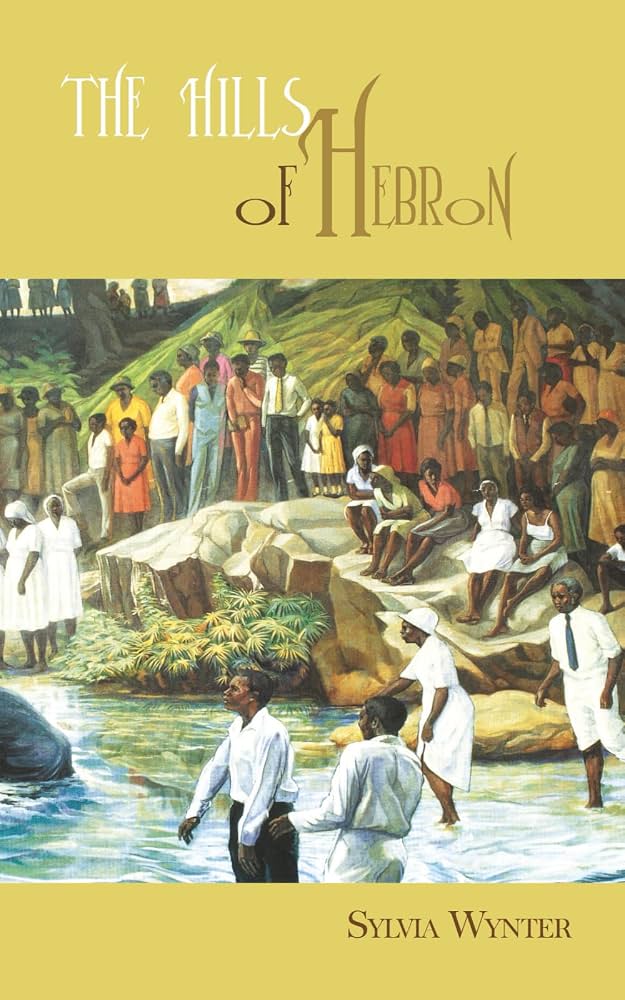
- Title:
- The Hills of Hebron
- Author:
- Sylvia Wynter
- Date of Publication:
- 1962
- Keywords:
- Community Sexuality Ritual Place Holy People
- Religions:
-
Christianity-Protestant majorNon Affliated-Atheist major
- Locations:
-
Jamaica major
- Wikidata Entity ID:
- https://www.wikidata.org/wiki/Q135475840
- Open Library ID:
- https://openlibrary.org/works/OL17338244M
- Item Type:
- Text
- Item Image Format:
- image/jpeg
Keyword Engagements
- Community
- Sylvia Wynter’s Hills of Hebron depicts the struggles of the New Believers, a Christian revivalist community formed in response to the visions of their prophet, Moses, of a Black Jesus. These visions provide an alternative to Christian colonial ministry and speak to an immiserated urban population. Following Moses’s death, the New Believers are buffeted by both natural disaster and the scandal engulfing the new leader, Obadiah, who is exposed publicly as having broken a vow of chastity – the evidence being the pregnancy of Rose, Obadiah’s wife. Through manipulation of the timeline, the novel eventually exonerates Obadiah; Rose was in fact raped by the son of Moses, Isaac. Unaware of Isaac’s crime, one faction of the community hopes Isaac, who has left the community for schooling, will return to lead the New Believers. Isaac ultimately betrays the community, stealing the few financial resources the New Believers have at their disposal.
- Sexuality
- The community in Sylvia Wynter’s Hills of Hebron celebrates heterosexual marriage and chastity within marriage. Obadiah, the community’s new leader, weathers scandal when he is exposed publicly for apparently breaking a vow of chastity and fathering a child with his wife, Rose. Outward celebrations of continence aide, the community is riven by sexual violence perpetrated by men and the silence of women as victims and witnesses. Moses, the community’s founder, rapes women in the community, fathering a child, Maverlyn. Gatha knows of Moses’s behaviour but refuses to speak out. Isaac, Moses’s son, rapes his stepsister, Rose, a crime about which Rose herself stays silent and which results in a scandalous pregnancy. Outside New Hebron, the local Anglican minister, Reverend Brooke, rapes his servant Gloria, fathering Rose. Learning of the crime, Moses uses his knowledge to blackmail Brook into helping him establish New Hebron.
- Ritual
- Sylvia Wynter’s Hills of Hebron depicts multiple ritual actions. Community life among the New Believers is structured by worship services with much emphasis on preaching, public prayer, charismatic experience, and communal singing. The novel opens with the community’s ritualised challenge during a church service to their new leader, Obadiah, for allegedly breaking a vow of chastity. At its foundation, New Hebron, a community that celebrates a Black Christ, sets itself in competition with the ritual practice, exuberant dance and song, associated with African religions and which would-be members must give up. The most striking exercise of all is the decision of Moses, the community’s founder, to crucified: an act for which the community prepares, celebrates with collective worship, and mourns following the prophet’s death.
- Place
- In Sylvia Wynter’s Hills of Hebron, community life is established on what the found Moses understands as a new Eden, heaven on earth: New Hebron. The community is established on unsettled land away from the region’s main urban settlement Cockpit Centre and the economic, political and religious influence of European colonialists. The novel depicts the effort and struggle of establishing the community: clearing land for settlement, horticulture, and the act of building structures such as a church and homes: as a master carpenter, Obadiah, the community’s future leader, is central to this activity. The novel is also sensitive to the practical realities of land ownership. Moses understands the importance of a legal deed to the land in establishing New Hebron. Without hope of purchasing the land, Moses blackmails Reverend Brook into helping him procure a forged deed. New Hebron, met to sustain the New Believers in their worship of the Black Christ, ultimately fails the community. The land is afflicted by drought, which destroys crops, blights landscape, and leaves New Hebron dependent upon Cockpit Centre where the New Believers are forced to use their sparse financial resources to purchase water.
- Holy People
- In Sylvia Wynter’s Hills of Hebron, Moses, is a charismatic figure who establishes, through powerful preaching and strategic relationship-building in Cockpit Centre builds, a community of New Believers willing to follow him and his visions of a Black Christ. His visions combine the political and religious: the preaching of the Black Christ speaks to an immiserated urban colonial population, used to being dehumanised by the economy and power structures of colonial Jamaica. Before New Hebron, Moses had attempted to establish an earlier community, but had failed and was committed by the colonial authorities to an asylum for the mentally ill. Through conversations with the alcoholic asylum warden, Moses develops the idea of a separationist Black Christian community. Moses outlined physical feats he would perform to both his communities, the failed community and New Hebron; for the first, Moses maintains he will fly (it ends with a broken arm and committal to the asylum), while New Hebron watches Moses’s crucifixion.
Attribution
- Citation:
- "The Hills of Hebron", Mapping Religion in the Global Anglophone Novel (MaRGAN), https://ghjensen.github.io/margan/items/margan042.html
Rights
- Rights:
- Metadata and other content produced by the MaRGAN team for this website is free for teaching and research purposes, provided appropriate credit is given. See https://creativecommons.org/licenses/by/4.0/ for more information.
- Standardized Rights:
- https://creativecommons.org/licenses/by/4.0/