RECORD
My Name is Asher Lev
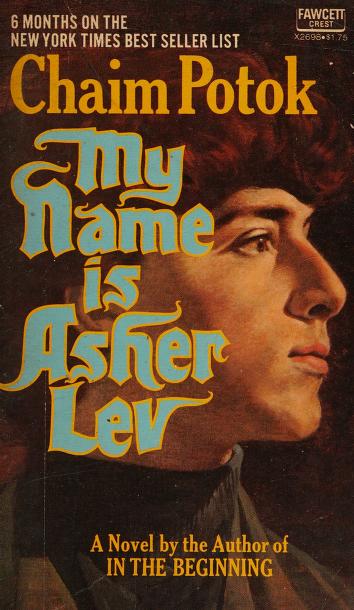
- Title:
- My Name is Asher Lev
- Author:
- Chaim Potok
- Date of Publication:
- 1972
- Description:
- My Name Is Asher Lev is a novel by Chaim Potok, an American author and rabbi. The book's protagonist is Asher Lev, a Hasidic Jewish boy in New York City. Asher is a loner with artistic inclinations. His art, however, causes conflicts with his family and other members of his community. The book follows Asher's maturity as both an artist and a Jew. (Source: Wikipedia)
- Keywords:
- Arts Image Holy People Ritual
- Religions:
-
Judaism-Orthodox major
- Locations:
-
United States major
- Wikidata Entity ID:
- https://www.wikidata.org/wiki/Q126712315
- Open Library ID:
- https://openlibrary.org/works/OL39803720M
- Item Type:
- Text
- Item Image Format:
- image/jpeg
Keyword Engagements
- Arts
- At the centre of Chaim Potok’s novel, My Name is Asher Lev, is the protagonist Asher Lev and his gift for art. The novel follows Asher’s childhood and young adulthood as he navigates his family’s Hasidic Jewish commitment, his parents’ desire for him to follow the family tradition of service to their Rebbe and his own desire to become an artist. From early childhood Asher has a gift for drawing and a desire to interpret the world around him through drawing and painting. He regularly draws his family, people in his community and the Rebbe (his community’s religious leader). From childhood he resists his mother’s attempts to persuade him to produce pretty drawings and instead focuses on representing truth. His parents, especially his father, fear that his art will take him away from Judaism. Throughout the novel Asher understands his ability to draw and paint as a gift, which he at times rejects and dislikes because of the conflict in causes within his family. The Rebbe intervenes, condones Asher’s drawing and sends him to Jacob Kahn, a great artist who is also a secular Jew. Kahn mentors Asher and teaches him about art, insisting that Asher must learn Christian art forms and history like crucifixions so that he can understand the history of art and form. Asher chooses to follow the path of the artist while also continuing his commitment to Judaism, concluding that creation and destruction in creativity, art and himself as an artist are inextricably linked. See also image.
- Image
- The opening of Chaim Potok’s novel, My Name is Asher Lev, gives the first mention of Asher Lev’s famous painting, the Brooklyn Crucifixion. The painting reappears at the climax of the novel. In the work, Asher paints his mother in the form of a crucifixion, as he attempts to portray her suffering from all the ways in which she has been torn between himself and his father. His family and community are shocked at his use of a Christian form and particularly one that is in ineradicably tied up with the history of violence against Jews. The Rebbe understands Asher’s need to use the form of the crucifixion because of its place in European art but the rest of his community does not understand and feels betrayed. Asher leaves Brooklyn for Paris in the midst of the turmoil caused the crucifixions. The Brooklyn Cruxifixion is foreshadowed earlier in the text where Asher studies and copies paintings of the crucifixion in order to capture the unique expression on Jesus’s face.
- Holy People
- The Rebbe is the religious leader of the community of Ladover Hasidim based in Brooklyn but with synagogues and schools around the United States and in Europe explored in Chaim Potok’s Novel, My Name is Asher Lev. The Rebbe is frequently invoked across the text but rarely appears. His first physical experience is in the synagogue, where he is described as being scarcely visible as his head and face are covered by a tallis (prayer shawl). Asher’s father is also a leader in the community. He works for the Rebbe and spends much of his time traveling in order to build up Ladover Hasidic communities in the United States and Europe. He regularly acts as the Rebbe’s representative and therefore has high status in the community. Early in the novel he assists several Jews in escaping from the Stalinist USSR, one of his many actions that give him the respect and admiration of his community.
- Ritual
- The significance of Hasidic Jewish practice in daily life is emphasised throughout Chaim Potok’s novel, My Name is Asher Lev. Jewish prayers, songs, Talmud study and the rituals of weekly Shabbos and annual festivals and holy days are referred to frequently throughout the text. The novels presents family life as structured by daily, weekly and annual repeated prayers and rituals, although the detail of the rituals is rarely given. As a young boy Asher mentions that he marks time by school tests and holy days and festivals. Several years after Asher first begins to study and work with Jacob Kahn, they spontaneously dance together holding a Torah scroll during the feast of Simchas Torah where Jewish delight in Torah is celebrated. This joyful moment is captured later by Kahn in a bronze sculpture that he is so fond of he keeps at home, thus marking the depth of Asher and Jacob’s connection and a rare moment of joyful connection between art and religion in the text.
Attribution
- Citation:
- "My Name is Asher Lev", Mapping Religion in the Global Anglophone Novel (MaRGAN), https://ghjensen.github.io/margan/items/margan044.html
Rights
- Rights:
- Metadata and other content produced by the MaRGAN team for this website is free for teaching and research purposes, provided appropriate credit is given. See https://creativecommons.org/licenses/by/4.0/ for more information.
- Standardized Rights:
- https://creativecommons.org/licenses/by/4.0/